
"Waste no more time arguing about what a good man should be. Be one."
-- Clara Oswald, quoting Marcus Aurelius.
(or, we might one day learn, Marcus Aurelius quoting Clara Oswald)
Name of the Doctor finally, after 50 years, established the Doctor's name - which is the one he chose all along, of course. Partly for his ego, to carry the weight of grand intelligence and studies. But he quickly became the man who saves, who heals, and who brings fear to the monsters. So how could that man make himself a warrior, live through centuries of killing and fighting, and end it by committing an act of double genocide? And how can he reconcile that with his name?
For three lifetimes and seven seasons, he really hasn't. And, we learn, during the war, he refused to even take the name Doctor. After 400 years, it haunts him. He tells himself he had to do it, to save the universe from being torn apart across every moment of time. And he did. He tells himself the Time Lords were as corrupt and as capable of destruction as the Daleks. And they were. Nor has the Doctor been against killing or violence, particularly when the Daleks were involved; after all, he destroyed Skaro itself. Yet that final decision is one a man like him - truly, a good man - could never fully live with. And in some way, the Time War has always hung over him throughout the revival.
From this, for the Golden Anniversary, Stephen Moffat makes the final definitive statement on the Time War. It's a great moral question: kill millions to save billions, or billions to save trillions or more. But given even the slightest hint of a chance, the Doctor's answer is to save them both. Which of course is his answer. It was always his answer, in every incarnation.

Moffat's stories, for all their tear-jerking and deep-rooted terror, are fundamentally optimistic. (Just as RTD's, for all their joy, were fundamentally cynical) So it's no surprise his answer to the war is different than RTD's in The End of Time. And thankfully, Moffat is perhaps the greatest writer ever to work on Doctor Who, and he brings the full force of his talent and skill to a story that could never be anything less than one of the grand epics of Who.
On the surface, of course, he does what you'd hope he would do: a multi-Doctor story. Which is what Who did for its 10th and 20th anniversaries, respectively. (and also the 30th, but we don't talk about that one) There's an inherent madness to the concept of a multi-Doctor story to begin with, made madder by the casual way it's done. It's a big deal, even in-Universe, but the actual insanity of the concept is brushed off with a few jokes before getting on with the fun stuff.
After a zippy introduction with the Eleventh Doctor and Clara being taken in by UNIT for an investigation, we're given a glimpse of a three-dimensional painting, a moment of time locked away in a frame (and a gorgeous visual effect), of Gallifrey's last day. After which, finally, after teasing us in both Name and Night of the Doctor, we meet The War Doctor on the day Gallifrey falls.

John Hurt's War Doctor gets a hell of an entrance, too -- first, just his
shadow lit on a wall by one of the fires of war. His gravelly voice commanding, "Soldier, I'm going to
need your gun." Even as the War Doctor, he uses a gun not to kill directly, instead, blasting "NO MORE" in a stone wall. A dying
Dalek cries: "What are these words? Explain... Explain!" Then, as a squadron of Daleks close in, the TARDIS flies in and destroys them. And we still haven't even seen his face. Mad Max didn't get such a knockout of an entrance.
(On the other hand, the last day of the Time War is really disappointingly generic. This is the war between the Lord of Time and the Daleks, the war that would have torn the universe itself asunder. Journey's End had the Doctor refer to Davros' ship flying into the jaws of The Nightmare Child at the Gates of Elysium. Day of the Doctor has a big laser fight with some explosions.
I mean, it's cool, and I realize it would have been hard to live up to that buildup, but they could have at least tried to make it look like something other than a Star Wars knockoff. The Dalek Choir from Journey's End plays on the soundtrack, and while it's always fun to hear, again, it feels more like a general sci-fi war anthem when something stranger seems needed.
Though, admittedly, it's a very slick, shiny, expensive Star Wars knockoff. As pure action film making, it's thrilling stuff, and looks like it came from a massively-budgeted Hollywood film. And not one of those modern CGI fests that are all starting to look like the same weightless cartoons; it's proper Hollywood spectacle, like Return of the Jedi or Independence Day. In particular, Mike Tucker's model work is absolutely sensational. I suppose there is something of an in-Universe explanation in that the Time Lords are losing and have already used most of their big guns. And "The Sky Trenches are holding" is at least in the realm of Time War-ish- my word, is this parenthetical still going?)

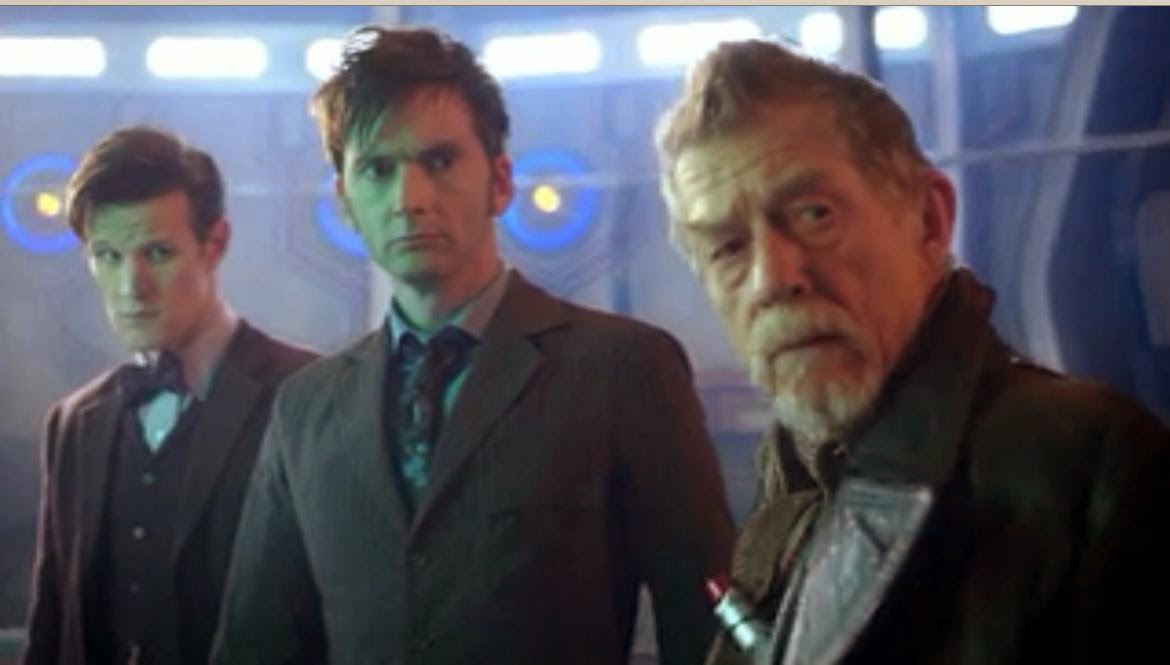
Hurt is fantastic, as you'd expect, and Moffat gives him plenty to work with. Even in a single episode featuring two other Doctors, War is a fully developed take with his own sense of humor, his own quirks, and his own character arc. Hurt plays it all to the hilt in a quietly commanding way, wisely underplaying to David Tennant's delightful melodramatic showboating and Matt Smith's frantic silliness.
The Doctor steals the Moment -- the Galaxy Eater, a weapon so powerful it developed a consciousness -- and finally, we get something Time War worthy. (Unsurprisingly, the fanciful name was RTD's, but the execution is all Moffat) The Time Lords never used it because "How do you use a weapon of ultimate mass destruction when it can stand in judgement of you?" The Doctor brings the Moment to an abandoned farm on a secluded planet (which we learn more about in Listen).
(It's here that we finally see a good shot of the War Doctor's face when he walks into focus. This seems like the time to bring up Nick Hurran's direction, which is at its best. His visuals are a dazzling yet story-driven as ever, the actors are fully-emotional, and even his usual flaw, the awkward staging, is done so confidently it feels more like a charming directorial quirk than, you know, awkward staging.)
I mean, it's cool, and I realize it would have been hard to live up to that buildup, but they could have at least tried to make it look like something other than a Star Wars knockoff. The Dalek Choir from Journey's End plays on the soundtrack, and while it's always fun to hear, again, it feels more like a general sci-fi war anthem when something stranger seems needed.
Though, admittedly, it's a very slick, shiny, expensive Star Wars knockoff. As pure action film making, it's thrilling stuff, and looks like it came from a massively-budgeted Hollywood film. And not one of those modern CGI fests that are all starting to look like the same weightless cartoons; it's proper Hollywood spectacle, like Return of the Jedi or Independence Day. In particular, Mike Tucker's model work is absolutely sensational. I suppose there is something of an in-Universe explanation in that the Time Lords are losing and have already used most of their big guns. And "The Sky Trenches are holding" is at least in the realm of Time War-ish- my word, is this parenthetical still going?)
Hurt is fantastic, as you'd expect, and Moffat gives him plenty to work with. Even in a single episode featuring two other Doctors, War is a fully developed take with his own sense of humor, his own quirks, and his own character arc. Hurt plays it all to the hilt in a quietly commanding way, wisely underplaying to David Tennant's delightful melodramatic showboating and Matt Smith's frantic silliness.
The Doctor steals the Moment -- the Galaxy Eater, a weapon so powerful it developed a consciousness -- and finally, we get something Time War worthy. (Unsurprisingly, the fanciful name was RTD's, but the execution is all Moffat) The Time Lords never used it because "How do you use a weapon of ultimate mass destruction when it can stand in judgement of you?" The Doctor brings the Moment to an abandoned farm on a secluded planet (which we learn more about in Listen).
(It's here that we finally see a good shot of the War Doctor's face when he walks into focus. This seems like the time to bring up Nick Hurran's direction, which is at its best. His visuals are a dazzling yet story-driven as ever, the actors are fully-emotional, and even his usual flaw, the awkward staging, is done so confidently it feels more like a charming directorial quirk than, you know, awkward staging.)

Unsurprisingly, the fanciful name of The Moment was RTD's, but the execution is pure Moffat. It appears to him as Rose. It's a brilliant use of Billie Piper, giving the feeling of seeing Rose again while giving Piper something much weirder and more fun to do. (I especially love her mockery of his "No more!")
"Don't sit on that! It's not a chair, it's a weapon of ultimate destruction!"
"Why can't it be both?"
Of course, she sees right through him and has plenty of fun ("If I ever develop an ego,
you've got the job."). But she's also deadly serious about, well, how deadly she is.
"There will be consequences for this."
"I have no desire to survive this."
"Then that's your punishment. If you do this, if you kill them all, then that's the consequence. You live."
So she opens a portal to the Doctor's future. And, naturally, a fez falls through. (The Moment: "Okay, I wasn't expecting that.")
So, having established this epic backdrop, Moffat draws us back into the other story, an engagingly silly multi-Doctor story with War, Ten, and Eleven together in a comic-horror plot involving UNIT and
Zygons. Here, he can essentially deliver what we expect in a big celebratory
anniversary while quietly layering the larger themes.

First of all, it's just wonderful seeing David Tennant back in the role, and he and Moffat both clearly relish every moment of it.

Jemma Redgrave's
Kate Stewart from The Power of Three returns, though she's far better
fleshed out here. She's introduced with a delightful note of whimsy - "The
ravens are looking sluggish. Tell them we'll need new batteries." But she's also given a darker side, as we learn that she runs The Black Archive, a location that's TARDIS-proof, and where the guards' memories are wiped every day. (I love how the horror of this is just casually swept under the rug.) And, ultimately, she's willing to make the same sort of violent, ultimate war-like decision her father would have made - and that the Doctor did make.
First of all, it's just wonderful seeing David Tennant back in the role, and he and Moffat both clearly relish every moment of it.
"What's that?"Although the highlight is his big speech to the rabbit.
"It's a machine that goes 'ding.'"
(The other flaw of the story, unfortunately, shows up here - Johanna Page's performance as
Elizabeth I is completely, painfully wrong. Page plays her as a broad, shrill comedy character, which actually tramples the humor and the characterization. Queenie from Blackadder was a more
dignified take on the character. Though I do kinda like Moffat's explanation of
the joke from the Tennant era of Liz hating him. She's also a relatively minor character, so it's not a major problem.)
Zygon Kate: We only have to agree to live.
Kate: Sadly, we can only agree to die.
Her relationship with the Doctor has
a little more of the sort of tension it should have, while being distinct from
his tension with The Brigadier. I love the Doctors'
angry look when Clara mentions The Black Archive. (Clara: So, you've heard of
that, then?)
Redgrave also gets to do some straight-out villainy, transforming into a Zygon. It's a fantastic make-up effect anyway, but Redgrave really sells it, especially with her off-handed delivery of the line, "They've probably just finished disposing of the humans a little early."
Redgrave also gets to do some straight-out villainy, transforming into a Zygon. It's a fantastic make-up effect anyway, but Redgrave really sells it, especially with her off-handed delivery of the line, "They've probably just finished disposing of the humans a little early."

Speaking of which, the Zygons are back, and relegated entirely to the B-plot. They're a really cool-looking monster who aren't actually that interesting and really have no
A plot to be told.
Even better than a rubbish old favorite returning is a new, totally not-rubbish, instant-favorite in Ingrid Oliver's Osgood, Kate Stewart's assistant. She's too good. A total Doctor fangirl, who not only wears a Scarf of Many Colors, but pretty much prays to the Doctor when she's in trouble. She's just about the nerdiest nerd ever, with both brainy specs and asthma. But Moffat isn't making fun of her in the slightest. (Teasing a little at times, maybe.) Being a Doctor fangirl has also made her extremely clever (deducing that the Zygons are pretending to be the statues), resourceful (escaping a Zygon by tripping it with her foot - and getting a great one-liner in the process!), and heroic (saving Kate from the Zygon's traps, marching into the Black Archive at her side). She's the perfect final touch - not just a representation of a Whovian in-Universe, but a Whovian who lives up to the Doctor.
Even better than a rubbish old favorite returning is a new, totally not-rubbish, instant-favorite in Ingrid Oliver's Osgood, Kate Stewart's assistant. She's too good. A total Doctor fangirl, who not only wears a Scarf of Many Colors, but pretty much prays to the Doctor when she's in trouble. She's just about the nerdiest nerd ever, with both brainy specs and asthma. But Moffat isn't making fun of her in the slightest. (Teasing a little at times, maybe.) Being a Doctor fangirl has also made her extremely clever (deducing that the Zygons are pretending to be the statues), resourceful (escaping a Zygon by tripping it with her foot - and getting a great one-liner in the process!), and heroic (saving Kate from the Zygon's traps, marching into the Black Archive at her side). She's the perfect final touch - not just a representation of a Whovian in-Universe, but a Whovian who lives up to the Doctor.
 |
| "Hey, you! Are you sciencey?" |
But, of course, the real fun of a multi-Doctor story is getting all three of them together in the same place, and with Moffat in charge, it's absolutely awesome. They mock each other, argue, and occasionally even accomplish things working together, with all the wit you'd hope for. (I especially like War's comments on the way they hold their sonics like guns. "They're screwdrivers! What are you going to do, assemble a cabinet at them?")

They also each get nice takes on the Doctor's general anti-authoritarianism. Eleven gets the banter with Clara about whether or not he has a job with UNIT (Clara knows he doesn't, because she gets him). Ten is far more horrified of the idea that he might be King of England than of the monster that just revealed itself. And War just generally exudes antipathy toward any authority he runs into.
It would pretty much be satisfying to just have them hang around for 75 minutes, but Moffat also uses their time in the prison cell to dig in and tear open the flaws of all three Doctors. Most compellingly, he contrasts how Ten and Eleven deal with their continued angst in the war. Ten keeps it forever at the forefront of his mind, his wounds forever unhealed. Eleven simply forgets as much as he can, which itself will never fully heal the wounds. (As they say, a doctor is his own worst physician.)

War: I don't know who you are. Either of you. I haven't got the faintest idea.
The Moment: They're you. They're what you become if you destroy Gallifrey. The Man Who Regrets, and The Man Who Forgets.
It's a brief but intensely dramatic sequence, that segues nicely into the Doctors solving the locked door by figuring out that since their Sonics are all fundamentally the same Sonic (the same software just upgraded into different cases), the War Doctor can start it on calculating the atomic structure of the door . Then, a few hundred years later, Eleven's has finished the calculations... which turns out to be a hilarious shaggy-dog joke when Clara barges in, revealing that the door was unlocked the whole time.
Which brings them back around to the Zygons, who traveled through time by hiding themselves in the 3D paintings that were frozen moments in time (bigger on the inside...), and they use the same trick, blasting through the painting of Gallifrey's fall into the Black Archive just in time. (along with a Dalek they just blew up)

War: Hello.
Ten: I'm the Doctor.
Eleven: Sorry about the Dalek.
Clara: Also the showing off.
Kate has turned into an opaque reflection of the Doctor, chosing to kill millions in order to save billions. Ten tells her it's a decision she will never live with, while Eleven winces painfully. The Doctor, naturally, forces them to make peace (the most perfect treaty ever, because he's the Doctor). The War Doctor, impressed, decides that the angst and suffering will be worthwhile to become a man (or men) who saves so many so effortlessly. As he says, "Great men are forged in fire. It is the privilege of lesser men to light the flame."
But Ten and Eleven (urged on by Clara, the Doctor's conscience as the Companion should be) show up to stand with him. As Eleven explains, "You were the Doctor on the day it wasn't possible to get it right."
Clara: We've got enough warriors. Any old idiot can be a hero.
11: Then what do I do?
Clara: What you've always done. Be a Doctor.
And then, again pushed by Clara, they refuse to push the button, and Eleven explains that he's been thinking about this for four hundred years, and with all three of them together, they can figure it out. Well, more than all three of them. All twelve of them. Or, rather, thirteen. (Was that moment chilling or what?)

And now the final parallels with the Zygon plot become clear. The Moment, by being the companionless War Doctor's conscience, paralleled the companion, perfectly embodied by Clara. (and managed to give us a taste of Rose Tyler, the companion who gave the Doctor much of the healing he did get after the war) The Painting, a frozen moment in time (which, after all, is what a picture is to begin with), is what the Doctor makes Gallifrey. The Sonic was made a clever reflection of the Doctor ("Same software, different face."); but, even more ingeniously, that shaggy-dog joke about the sonic's calculations was the set-up for the finale -- the calculations could be begun with the First Doctor.
Time Lord: Why would you do that?
11: Because the alternative is burning.
10: And I've seen that.
11: And I never want to see that again.
Time Lord: ... we'd have nothing!
11: You would have hope.
That's Moffat's greatest trick here: using a small comedy to make a staggering epic greater, and the epic elements to give the humor more tension and punch. It's a magnificent trick he seems to pull off effortlessly. He built to a climax of thirteen Doctors saving Gallifrey from the Daleks and the Universe from Gallifrey, and earned it with a bunch of jokes about screwdrivers.

And he does it without erasing all the compelling drama the last seven seasons have pulled out of the Time War, which was a powerful idea to begin with. Since the War and Tenth Doctors forget about it, their successors' character arcs still stand. And War gets a moving final moment, getting to feel as though after centuries of warfare, he is truly the Doctor again.
And then Moffat can't resist and throws in The Curator, who pours his heart and soul into his brief moments. His broad delivery of "Gallifrey Falls No More" is both rousing and deeply moving, the final catharsis of a fantastic story.
(On a smaller note, I love the way Nick Hurran goes to
handheld when you hear the voice, before we actually see him, adding that great little bit of extra tension.
The cameo literally shakes the world.)
(I also love how the scene uses music from The Big Bang and Wedding of River song.)
(And I especially love gratuitous parentheticals.)
(I also love how the scene uses music from The Big Bang and Wedding of River song.)
(And I especially love gratuitous parentheticals.)

These anniversary stories reflect a lot about what the creators think the show is. The Three Doctors is a non-stop array of mad ideas and whimsical humor building to a conclusion that's simultaneously epic and a few old Brits standing around in a room theatrically drama-ing at each other. (which sounds like a pretty accurate description of the show to me) Conversely, The Five Doctors is a slick (by low-budget early 80s TV standards) series of set pieces and pointless continuity references strung together efficiently. It's a very watchable take on everything that goes wrong with the show in the 80s. And it would have been easy for Day of the Doctor to fall in the same trap.
But Moffat is too good for that. He brings the full force of his wit to the dialogue, loading it with not only the expected banter between Doctors, but with rich, multi-layered meanings. The story is perfectly paced and structured to give both the sweeping A-plot about the Time War, and the small, comic-horror Zygon B-plot all the time they need without slowing down. It aims long and scores a bulls-eye.

It's more worth comparing to The Three Doctors, then. Every place that one succeeded - imagination, concepts, humor, and cast chemistry - this one excels further. And naturally, with the advances in technology and vastly larger budget, it exceeds it technically. But it's in the story where Day proves truly masterful; The Three Doctors is content to be a wild ride of ideas and jokes, its story and themes amounting to little more than a bigger threat than usual. (probably) "Merely grand entertainment" is a silly flaw to accuse something of, and I'm certainly not doing that. But when a work like Day of the Doctor manages to be just as grandly entertaining and deliver a powerful, meaningful drama, too, it simply shows how great Day is in comparison.
RATING:
* * * *
SIDENOTES

- Clara is introduced having graduated from nanny to a teacher (at Coal Hill School!). It's a great character moment without having to be announced as one in any way; she's truly dedicated to children. And then rides her bike right into the TARDIS. She doesn't get a lot to do in the story, which naturally is about other things, but the little she gets is fantastic, and builds on what's already been established about her. I complained throughout series 7 about her being underdeveloped, but I think the problems were elsewhere, because everything wonderful and vivid about her was there in series 8.
Put another way, how did it take Deep Breath to realize that Clara is AWESOME!

- I love the War Doctor's TARDIS - a nice melding of Classic and New styles of the TARDIS.
11: Hey, look, the round things!
10: I love the round things.
11: What are the round things?
10: No idea. - The Zygons lost their home in the first days of the Time War... which makes Terror of the Zygons a minor side part of the Time War, right?
- I actually first saw this projected at the Austin Comic-Con last year, which was a phenomenally cool way to see it. I mean, I missed some of the jokes because the audience was laughing too hard and the previous jokes, but the experience of seeing a great movie with an enthusiastic audience is always a wonderful experience. They really went wild for Tennant's final line, but I think I was the only one who laughed out loud at Kate's line about the dates on UNIT files: "The 70s or 80s depending on the dating protocol used."


