Tuesday, November 4, 2014

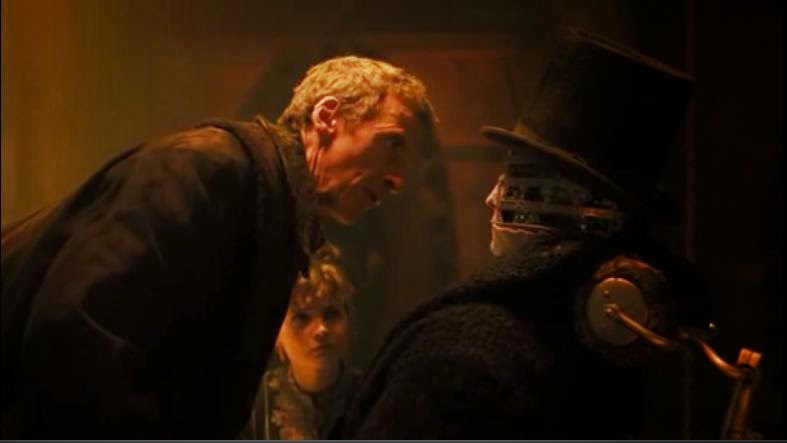
Into the Dalek


Doctor: And isn’t the Universe beautiful?
Rusty: I see beauty… I see endless, divine, perfection.
Doctor: Make it a part of you. Put it inside of you, and live by it.
Rusty: I see into your soul, Doctor. I see beauty. I see divinity. I see… hatred.
Doctor: Hatred?
Rusty: I see your hatred of the Daleks, and it is good.
Doctor: No, you must see more than that, there must be more than that…
Rusty: Death to the daleks! Death to the Daleks!
Doctor: There must be more than that, please!
Rusty: DALEKS MUST BE EXTERMINATED! DALEKS ARE EVIL!
One of the really fun things a long-running series can do is revisit and refresh old concepts with some new ideas. Done wrong, it can just be a dull rehash, but done right, it gives the old concepts new life, and finds new things to say. Into the Dalek combines the Fantastic Voyage-esque miniaturization ray trip inside the Doctor’s mind from The Invisible Enemy with Rob Shearman’s exploration of a Dalek confronted with some sense of morality in Dalek and Moffat’s take on an insane Dalek in Asylum.

A variation on a theme by Shearman, remixed with Baker and Martin, if you will. And while the result isn’t a masterpiece, it’s intriguing enough to be a worthwhile take.

One problem with bringing back the Daleks all the time is that they lose their impact, unless you’re actually able to come up with new things for them to do. In this case, it’s literally going into the mind of a Dalek (dubbed “Rusty” by the Doctor) inexplicably turned good. So we get the always delightful trick of having the Daleks say something non-evil in their voices of pure evil:

ALL DALEKS MUST DIE. I WILL DESTROY THE DALEKS! DESTROY THE DALEKS!

Well, non-evilish.

The Doctor abruptly shows a very emphatic rejection of soldiery throughout the episode. While it does come a little out of nowhere, it’s not particularly strange for him to object to it, and his reasons -- that soldiers take orders and that Daleks are perfect soldiers -- add up. (Notably, though, this does work a lot better in The Caretaker, where it’s more thoroughly explored.)


Journey Blue: You don’t like soldiers much, do you?
Doctor: You don’t need to be liked. You’ve got all the guns.
Capaldi also gets to show off his wit throughout here, and it works a lot more often than it did in Deep Breath; the whimsical doesn’t go smoothly, but the nasty stuff? Very funny. (Which isn’t a surprise, of course, to anyone who’s seen Capaldi’s Malcolm Tucker, but it’s still fantastic to see in the context of someone who isn’t completely awful in every way.) “Dry your eyes, Journey Blue. Crying’s for civilians. How we communicate with you lot.”


Notably, he doesn’t have a problem with their bravery or fighting itself.

Carlyle: Tell me the truth. Is he mad, or is he right?
Clara: Hand on my heart? Most days he’s both.
Carlyle: One question then. Is this worth it?
Doctor: If I can turn one Dalek, I can turn them all. I can save the future.
Carlyle: Gretchen Allison Carlyle. Do something good, and name it after me.
Doctor: I will do something amazing. I promise.

But it culminates in the painful scene where Journey Blue asks to join the Doctor and he rejects her. “I think you’re probably nice. Underneath it all, I think you’re kind, and definitely brave. I just wish you hadn’t been a soldier.”

That’s not the Doctor’s only unsympathetic moment here; when he finds what’s wrong with Rusty, he fixes it basically to prove the point that Rusty can’t possibly be good. Clara (literally and rightly) slaps him back to reality and helps him realize that even in this Dalek, who represents everything he hates about soldiers, there was something good. The point is not that Daleks are naturally evil; it’s that they can be made to see beauty.

This parallels nicely with the introduction of Samuel Anderson as Danny Pink, an ex-soldier, now a teacher at Coal Hill that Clara takes a fast liking to. Danny is effectively sketched out in just a couple of scenes; first, a potent moment when a student starts asking him if he killed anyone in the war. He first answers ambiguously, but the student presses him, (the little twerp) asking if he’s killed any civilians. Pink’s only answer is an involuntary tear.


He meets Clara soon after, and engages in some banter, but nervously turns down her invitations to get together. Anderson deserves tremendous credit for making Danny work right off, getting both the humor and sadness at the core of his character, and never losing the sight of his soldiery.

Danny: There’s more to modern soldiering than shooting people. I like to think there’s a moral dimension.
Clara: Ah, you shoot people, and then you cry about it afterwards.

I love how the next scene cuts between their actual conversation and Danny afterward beating himself up for what he should have said. Even more striking, though, is Clara. We see her usual wit turned just a little too harsh for a moment. Moffat has more than once written witty characters who were utter jerks with their wit (Sherlock probably being most obvious, but most of his leading male characters), but I don’t remember him turning it on one of his female characters before. Which is not to say that Clara comes off as awful, just that her usual joking becomes insensitive because she can’t resist saying the clever thing that jumps to mind. It’s yet again one of the brilliant little details about her character that make her a little more real. And Coleman excels at ever bit of nuance she's given and adds more.


Their brief interactions here are charming and remarkably rich in character given how few minutes they spend together. It's a good set-up in itself, and it's only going to get better.

This subplot, in addition to fleshing out Clara further, gives greater resonance to the Doctor’s rejection of soldiers. Nothing else needs to be said, but it hangs over the story throughout In the background, Clara looks gutted. There’s more to it than just knowing the Doctor is going to reject her possible new boyfriend, but, especially for a control freak who puts on acts for everyone, it spells doom right from the get-go.

All this manages to be put through a non-stop action yarn that brings us through some of the best sets Who has had in years. The whole journey through the Dalek delivers plenty of imagination and cool imagery, and finds fun variations on the expected Fantastic Voyage elements, my favorites being the bizarre entry into the eyestalk and the nasty sequence in what passes for a Dalek stomach. It's not so much the visceral grossness (although that's undeniable) as much as it is Capaldi's marvelously deadpan description of where they are.


The downside here, though, is that Into the Dalek too often relies on characters doing dumb things they really shouldn’t. What it comes down to, really, is the one major hole in its look at soldiers: they’re professionals. Samuel Anderson effectively plays Danny with a sense of disciplined professionalism, but the soldiers on the ship are too often idiots to serve the plot.

Take the moment the Doctor re-activates Rusty, a couple soldiers open the doors, rush in, and, of course, get shot. And the Dalek gets free and starts roaming about. Not only do we have to roll with the staggering stupidity of running into a room with an active Dalek, but we have to wonder why they would have put it in a situation where re-activating it would put it in a position to immediately escape and run amok. Shouldn’t it be, like, chained to a wall or something?

These are soldiers who have been fighting Daleks for a long time; they should know better than to do something like that. And maybe they should fight a little more strategically. The battles are flashy and fun, and find all kinds of cool new ways to blow up Daleks, but they're choreographed to make the soldiers come off as pretty incompetent.

The climax is set up a bit oddly, with the Doctor sending Clara off to “do something clever” and figure out how to fix the Dalek computer brain while he tries to reason with it. Clara, remember, is hopeless with technology, and excels at helping others see the light. Clara does do something clever (that’s what she does, after all), but she really does luck out, what with the solution basically coming down to pushes a bunch of big red buttons. And the story wouldn’t end as effectively if the Doctor didn’t feel as though he had failed by instilling in the Dalek his own hatred of that race. It’s a forgivable contrivance.


This is grand stuff. Unfortunately, it depends far too much on previous stories for its power. Nothing in this episode actually earns its dependence on the Daleks as the ultimate evil. Yes, there are big, flashy laser fights and hints of “kill all life” rhetoric, but it’s really just a little bit of emotion to hang the big action set-pieces on rather than especially compelling drama. It’s not that their history can’t do a lot of the heavy lifting, but it would help if Into the Dalek did a little bit of the lifting on its own.

Still, at least that has history on its side. The Doctor’s questioning Clara about whether or not he’s a good man comes completely out of nowhere, apropos of nothing. And it’s not like he has a lot of reason to wonder; we pretty much spent the entire “Of the Doctor” trilogy, plus, you know, about 98% of every Who story, ever, from about The Sensorites onward, establishing that he’s complex and has a dark side combined with a cold alien approach, but saves the universe because underneath that he's the most heroic good guy ever. This season comes back to this idea a few times, and actually earns it, which makes this one play even worse on a repeat.

It’s really too bad, because if you can stretch and buy the concept (and it does basically make sense by the finale, even if it really needed to be clear a lot earlier to stick), it pays off nicely throughout. Clara’s answer, that she doesn’t know, is a surprisingly thoughtful take on how she would answer. Where most companions would either answer honestly in the affirmative (and a few, like Amy, would lie even after he asked for complete honestly), Clara is truthful. She hasn’t entirely figured out the whole “good” thing herself, and certainly can’t answer for her 2000-year-old friend in completely honesty. (Leela and Tegan might also have answered ambiguously, but I’m not sure any others would.)

What it finally gets at, in the climax, is that the Doctor is consumed by hatred for the Daleks. And while, in some sense, it’s probably earned, (and the Doctor's horror at his own hatred felt a little awkward to me in Shearman's superior Dalek, too) it’s a purely negative, destructive emotion. Dislike or even rage are one thing; hatred is another. Rusty does remember beauty, thanks to the Doctor, but he also consumed the Doctor’s hatred for the Daleks. Ultimately, according to Rusty, the Doctor is a “good Dalek”.

If there’s a moment that makes me like the episode in spite of its faults, it’s that magnificently ambiguous climactic statement. To the Doctor, it’s devastating; he takes it to mean that his hatred defines him as it defines the Daleks. But is that how Rusty means it? Could he have meant simply that the Doctor is a good soldier, since the Doctor defined the Daleks as the ultimate soldiers? Not that the Doctor would take kindly to that itself, but it’s at least easier to swallow. Or perhaps Rusty truly means to say the Doctor is a good man. 


Clara’s final answer, too, is lovely: she’s not sure the Doctor is good, but he tries. And, to her mind, that’s the point. Like Rusty’s take, it’s not entirely satisfying, but it’s hopeful.

Rusty: And yet, new stars are born everyday. Resistance is futile!
Doctor: Resistance to what?
Rusty: Life returns. Life remains. Resistance is futile.


RATING: 

* * *


SIDENOTES: 
  • Murray Gold mostly uses weird synth music here, reminiscent of the terrific Radiophonic music of the early Dalek stories. Much as I like his bold orchestral approach to most of the show, I love this here. He actually spends most of the season going smaller; it's effective and less often intrusive at the expense of being less often memorable, but it's a fair trade-off.
  • It is a little weird that the Doctor so fully rejects the idea that a Dalek could be good when he's literally staring into the face of a pretty damn good one.
  • “We made it. Nobody popped.” Nice bit of subtle one-line horror.
  • I like the focus on women here - Journey and Gretchen, the two non-stupid soldiers in the Dalek are women, and since the red shirt gets incinerated pretty early, it's basically three women and the Doctor for the majority of the episode. For all that I think the "Moffat is sexist" crowd is wrong, I suspect this season's greatest emphasis on female characters may have been a reaction to that crowd. Just because the last few seasons of the show have probably done women better than they've ever been done on the show doesn't mean it can't be improved, and Series 8 does a fantastic job pushing further into a truly feminist take on the show.
  • “This is Clara, she’s not my assistant, she’s some other word.”
    “Your carer.”
    “Yeah, she’s my carer. She cares so I don’t have to.” 

Sunday, November 2, 2014

Deep Breath


Doctor: Clara, what is happening in this restaurant right now is more important than your egomania.
Clara: Nothing is more important than my egomania!

Total spoilers for Dark Water. Well, and this, obviously.

New Season, new Doctor, new Era. Steven Moffat, of course, is still around, and dives right into his usual madness, and we’ll follow suit.

Unsurprisingly, Capaldi is great right from the start. His  primary take on the Doctor - the most alien and off-putting of  them all - is the most obvious straight away. He casually talks  to the dinosaur without acting like there's anything at all  strange about it. He's baffled by the concept of a bedroom.  ("You've got a whole room for not being awake in?") Similarly,  his fondness of clever insults shows up already: calling Strax by  the names of some of Snow White's dwarfs, Clara "the not-me one,  the asking questions one", and Earth "Planet of the  pudding-brains."

The harsh alienness never takes away from the other Doctorish  traits. He opens a door, stops, says, "Door, boring, not me,"  then closes the door and goes out the window. His strangeness and  insulting nature never bury the Doctor's essential compassion,  nor the way he turns cold to true villains. ("Those people down  there, they're never small to me. Don't make assumptions about  how far I will go to protect them, because I've already gone a  very long way.") And certainly his intelligence is undeniable; there's a lovely tang of suspense when he tells Clara and the Paternoster Gang that the mystery of the incinerated T-Rex in 19th Century London is neither who nor how. And it's almost chilling when he reveals the answer: "Have there been any similar murders?"

Naturally, his climactic confrontation with the villain is superb, starting with his casually pouring two glasses of brandy.

Doctor: I’ve got the horrible feeling I’m going to have to kill you.  Thought you might appreciate a drink first. I know I would.
If there's one thing that doesn't completely come off, it's the  humor. Capaldi's rough, intense take doesn't jibe smoothly with  the silliness until Listen, though there are still plenty of  great moments. ("“These are attack eyebrows! You could take  bottle tops off with these!” “I hate being wrong in public,  everyone forget that happened.”)

But, oddly, the new Doctor isn't the most interesting part about  the episode. I'll talk about Capaldi's Doctor more when he gets his first masterpiece in Listen, but until then, it's consistently fun to watch his intense alienness.


For his second post-regeneration story, Moffat has the advantage of not actually having to reinvent the entire show, and so can just drop the Doctor into a lot of his familiar tropes and get one with telling a good story. It's a clever mix of witty dialogue and grotesque horror with simple but clever gimmicks pushed as far as they can go and no further. He has an ingenious sense for how to sketch concepts like "people not eating at a restaurant" and "hold your breath" into heart-pounded set-pieces.

He also sets up the season thematically with impressive precision. The nastier variation on the fantastic clockwork robots from The Girl In the Fireplace nicely prefigure the Cybermen. ("Droids harvesting spare parts. That rings a bell.") Rather than humans losing their humanity by replacing their parts with machines, the robots are becoming more human by replacing their parts with organic matter. That humanity, as usual, is represented by emotion, both the highs and lows. Emotion works against "basic programming", for better or for worse, a theme that comes out throught the season. And the focus of emotion defines the difference between the robot and the Doctor:
“There’s more human in you than droid. So tell me, what do you  think of the view?”
“It is beautiful.”
“No, it’s not. Everything’s far away, it’s too small. I prefer  down there. Everything’s huge. Everything is so important. Every  detail, every moment, every life.”
Similarly, their state of living death effectively introduces the season's exploration what death means and how it changes those who survive it. This climaxes here in the obvious arc-phrase "We will reach the promised land" and its payoff in Missy introducing the robot to her heaven. It's more setting up ideas and mysteries here than going for a point, but it's certainly a provacative set-up.

I burned an ancient, beautiful creature for one optic nerve.  What do you think you can accomplish, little man?!
The opening scene itself doubles as a first showing of the season's view of science. The T-Rex is inconsistently about 10-20 times too large strictly so that it can convincingly have the TARDIS stuck in its throat, and so it can have that iconic moment of standing next to Big Ben. (Big Ben is 96 meters tall, while a T-Rex stood about 4-6 meters.) Jenny even comments on it:

Copper: I bet you’ve not seen anything like this before.
Vastra: Well, not since I was a little girl.
Jenny: Big fellow, isn’t he?
Vastra: Dinosaurs were mostly this size…
Jenny: No they weren’t! I’ve seen fossils.
Vastra: I was there!
This attitude can be viewed positively as silly fun or negatively as straight-out contempt for actual science, depending on your mood. Here, as basically a throwaway joke, I find it easy to roll with, but it'll be a lot more interesting to talk about this in Kill The Moon.

But that's not quite the most interesting part here, either.

Moffat also uses what has now become one of the fairly standard set of his era's tropes -- a Victorian sci-fi mystery co-staring Madame Vastra, Jenny, and Strax. They're always a delight to see, of course, and Vastra gets her best material yet.


There are nice little touches for her here: her prime loyalty to the British Empire in particular is charming. She also finally gets to actually use that sword she's been dragging around all this time... only for it to be wasted in an entirely incoherent action scene. (The only major misstep of Ben Wheatley's generally excellent direction)

Far more importantly, she's fleshed out a lot further as a character, and fully delivers on the promise she's always shown. First is the wonderful moment when she gets the Doctor to sleep by faking a Scottish accent and saying, "Doctor, I need your help." She makes him putty in her hands by playing right into his ego.

Similarly, she's able to draw out Clara's fury by scratching at her flaws; this naturally brings out Clara's strengths. Vastra shows a remarkable understanding of people's complexities and intracacies, and an equally remarkable adeptness at manipulating them.

That same scene with Clara also showcases the power she draws out of her nature. She's a Silurian, and to the Victorians, it's a "disfigurement"; she's ugly simply because she wasn't born with what they consider beautiful features. So she wears a veil when dealing with such despicable creatures, not "as a courtesy to such people, but as a judgement on the quality of their hearts." Her fury, though, is not directed at Victorians disliking lizard people; it's directed at us, at our culture that valorizes youth and perfectly smooth skin and symmetrical faces as not only the definition of physical beauty, but of a woman's value.

And even Clara, to some extent, sees her as something else at first, and compares it to the Doctor's face being different. But Jenny doesn't for a second see her as anything less than beautiful. "I don’t like her, I love her. And as to different, well, she’s a lizard." 

 When Clara asks when Vastra took off her veil, she says it was when Clara stopped seeing it. And that, often, is how we, unfortunately, end up relating to people who don't meet our standards of beauty: we treat them as ugly until we know them well enough that we don't see the veil anymore. 

Moffat has come under fire from some corners for his perceived poor portrayal of women. While there are across his writing some weakly written females (Tasha Lem feels like his favorite tropes without the underlying humanity driving similar characters like River Song and Irene Adler), I think any consideration of his body of work puts a lie to that criticism, and one of the easiest arguments against it is Madame Vastra.

This is magnificent all on its own. But it gets to the really interesting part of the episode: Clara.


After all, she didn't seem to consistently work in Season 7. The complaints (coming from seemingly all corners, including mine) mostly ammounted to her being too "generic" a companion. And while it was plainly easy to see how she wasn't like, say, Amy, it was a little harder to put a finger on what exactly distinguished her.

So Moffat spends much of the episode focused not on the new Doctor, who spends much of the story disappearing from our view until he needs to popup again. The focus is almost entirely on Clara, and making her work as a character. And oddly, all he actually does is strip down all the whimsical aspects of her character.

After all, she is, as she described herself in Time of the Doctor under the truth field, a “bubbly personality masking control freak.” On top of that, she spent most of Season 7 as such a mystery (“Who is the impossible girl?”) that even the resolution (“Just a normal girl who did something extraordinary one day”) didn’t make it clear who she was, as such. So take away the mystery, and put her in a situation where her bubbly personality falls away (in this case, horrified by the Doctor’s regeneration and stuck in a series of bizarre horror scenes to boot), and we can plainly see just what a vivid character she is.


And everything we see is stuff that was already there. Deep Breath spends a long time on Clara’s flaws - she’s an “egotistical, needy game-player” in the Doctor’s words, a control-freak in her own. (Or, in Strax’s words, examining her subconscious: “Deflected narcissism, traces of passive-aggressive, and a lot of muscular young men doing sport.”) These are on display throughout the episode, most obviously in her obsessive need for the Doctor to be “her” Doctor and the incredible difficulty she has accepting him. It takes not only Vastra tearing her a new one and the Doctor saving the day. It takes the Eleventh Doctor calling her from the past-future* to finally bring her to accepting the new Doctor. (as opposed to Rose, who pretty much accepted the new Doctor as soon as he bothered to wake up and push the big red button)

*non-linear, non-subjective ball of wibbly-wobbly timey-wimey stuff

But you can see, for instance, the control-freak thing all the way back in Bells of St. John - the way she grabs at the laptop and takes control of the whole scene (“Gimme!” followed by “Pop off and get us a coffee.”). Or the way she similarly takes all the control from the Doctor in the last scene, and refuses to leave her own life to go on adventures, instead treating the adventures like her weekend hobby. (There are also hints of these things in Asylum and Snowmen, though not quite as clearly.) The control-freak nature is largely a reaction to her self-image and need to be accepted, and she puts on a show for everyone - see, for instance, her accidentally inventing a boyfriend and using the TARDIS to undo missed birthdays or, you know, cook her turkey in Time of the Doctor.

These aren’t always bad things, and it’s lovely the way she refuses to let the Doctor control her life. Clara is pretty aware of her flaws, and, like Madame Vastra, turns her weaknesses into strengths.


And it’s not like she doesn’t have strengths - she’s always been extremely intelligent and clever, and loves working with children. Nor is her bubbly personality entirely a front - she’s genuinely witty and good-natured, and sweet when not backed in a corner. (She’s as cold as the Doctor when she is, though. Watch out for this one.) You put everything about her together, and you end up with a mess of good and bad, brave and cowardly, clever and distracted. Which is to say, a real person. Big and vast and complicated and ridiculous; a universe and a miracle, stuck in a two-meter-tall bag of mostly water. The whole season emphasizes this, exploring all the complexities and pains and triumphs of Clara’s life, making her a more vividly real person than most characters on the grittiest and most normal TV shows. And she’s a fantastic companion, to boot.

But it’s all on full display here, and plays out spectacularly in the last third. You see the Doctor and Clara wandering the spaceship and truly working like equals, before he abandons her. Of course, as it turns out, he was simply letting her work as a distraction and trusting her to be clever and brave. The Doctor knows her and trusts her, and she delivers.

First, she figures out that the way to defeat these robots is simple: hold your breath. But there’s only so long you can do that, and the result is a harrowing sequence. She holds her breath until a tear falls, and leaves that room only to find another room just as full of the evil robots. Her vision is filled with flashes of red and yellow, until, at last, she faints.


And she dreams of teaching the children, and in particular, the chaos of the first day. When she threatens to expel the whole class, a particular troublemaker (who turns out to be Courtney Woods) challenges her to just go ahead and do it.

She’s intelligent enough to learn from her experiences (which, speaking from experience, is a pretty rare intelligence), and uses it. So when the Half-Face Man (which I just learned from Wikipedia is the villain’s name. That website is way too useful.) threatens to kill her if she doesn’t say where the Doctor is, she refuses, and uses the same line. “Do it. I’m not going to answer any of your questions, so you have to do it. You have to kill me… And if you don’t, I’m not going to believe a single threat you make from now on… Of course if I’m dead, then I can’t tell you where the other one went.”

“Never start with your final sanction. You’ve got nowhere to go but backwards.”
“Humans feel pain.”
“Bigger threats to smaller threats, see what I mean? Backwards.”
“The information can be extracted by your suffering.”
“Are you trying to scare me? Because I’m already bloody terrified of dying. And I’ll endure a lot of pain for a very long time before I give up the information that’s keeping me alive. How long have you got?”
And there it is - when she’s scared, she draws power and bravery from that. “Okay, yes, I’m crying, because I’m very frightened of you, and if you know anything about humans, that means you know you’re in a lot of trouble.”
She figures out both that the restaurant needs to stay secret and that since they know what’s in a dinosaur’s optic nerve, they’ve been rebuilding themselves for millions of years. So she ingeniously agrees to answer the Half-Face Man’s questions he if answers hers.

This is a marked contrast to, for example, Amy, whose bravery was usually a tremendous bluff until things got a step too horrific, and she faltered. Amy might have figured out the same ploy, but would have gone about it completely differently: she would have insisted she wasn’t scared at every turn, even as her face betrayed her. And when the Doctor did show up, it would be when she was at the point of collapse, rather than Clara, who basically forces the Doctor to play his hand by answering the Half-Faced Man’s question. “I know where he will be, where he will always be. If the Doctor is still the Doctor, he will have my back.”


Director Wheatley brilliantly holds the suspense for an agonizingly long time before the Doctor appears by pulling off the face he was wearing as a mask. (Which, if you recover from the sheer horror of the Doctor pulling a Texas Chainsaw Massacre move before he goes on being his usual brilliant self, you might notice is a clever payoff to the various subplots about the Doctor’s new face, both in Clara’s storyline freaking out about his change, and in his own, trying to figure out where he recognizes that face from, insisting that the mirror looks angry. Or you might just freak the hell out.) The otherwise insulting Doctor praises Clara’s ingenuity, bravery, and ability to use her control-freak nature to her advantage in a dangerous situation. “Five-foot-one and crying, you never stood a chance.”
“I’m sorry. Actually, I’m not. You’re brilliant on adrenaline. And you are out of your depth, trying to control a control freak.”
“I am not a control freak!”
“Yes ma’am.”
(I imagine that will set up a confrontation between Clara and the Master Mistress in Death In Heaven. In fact, I’ll probably consider it a significant failing if she doesn’t, because setting up the ultimate control freak against a person who literally named themself variations on “Master” is too obviously awesome to pass up.)

What this definitely also begins for this season is a surprisingly strong commitment to morality. Not that Doctor Who typically preaches that evil is cool, but Series 8 remembers that this is a family show, and in amidst all this ridiculously complicated thematic and character complexities that are driving me mad as all these damn reviews keep going on for thousands of words to parse out, Moffat and his writers put a lot of thought into what lesson, exactly, the kids watching are going to take from it. And here, as with much of the season, it’s a lovely one: use your fear and cleverness and weaknesses as weapons when you’re in trouble.

Of course, the season also goes on to expand on the idea hinted at here that Clara turning her weaknesses into strengths in all aspects of her life greatly magnify her weaknesses, but that doesn’t invalidate the beautiful, simple truth here.


It’s also, of course, about not judging people by the appearances, and I honestly haven’t seen many explorations of that better than this one. It finds a lot of ways to do it and play with it, never falls into hypocrisy, and never preaches or gets heavy-handed while remaining crystal-clear on the message.

For all that, it’s not quite a perfect episode. In addition to the clumsy fight scene and occasionally slightly off-target Doctorish humor I referenced way too many pages ago, there are occasional pacing issues and rough transitions between the many different tones.

Thankfully, the pacing issues are very different from before: it doesn’t feel rushed or underdeveloped, carefully exploring all its ideas thoroughly through 75 minutes. It moves along efficiently enough, just struggles with scenes here and there. This, too, prefigures the season, which is careful to have exactly the right amount of ideas for the episode’s length, and completely work through those. Only a couple of episodes feel rushed, and even there, the problems really could have been solved within the episodes themselves; they’re cases where making them 90 minutes would have required making them much more complicated rather than just letting everything take a deep breath here and there. (rimshot)

But whatever doesn’t work here is minor. You’ve got dialogue rich with both wit and meaning, an intriguing new take on the Doctor, a magnificent characterization of Madame Vastra, skin-crawling horror (literally), phenomenal thematic material, and the Impossible Girl becoming absolutely awesome. What more could you want from a season premier?

(The answer is Madame Vastra Flynning it in a swordfight worthy of her. Where’s William Hobbs when you really need him?)


RATING:


* * * ½


SIDENOTES: 

  • Strax is great, too, of course ("You must stop worrying, my boy. By now, he’s almost certainly had his throat cut by the violent poor."), but there's not much to say here other than to praise the abilities of Moffat (and Mark Gatiss) to keep a one-joke character so funny for so long.
  • One more theme of the season of sorts: perfecting the experiments of the Smith era. For much of the season, it's the complexity of the companion's character arc (Amy, Rory, and River had great arcs, but they didn't always quite click correctly; Clara's is incredible) and making the 45-minute format work more often than not. Here, though, it's mostly getting the Silurians to work in a modern context. The Hungry Earth / Cold Blood reintroduced them without actually doing much more than rehashing the classic series episodes other than the fantastic makeup. Creating Madame Vastra finally solved the problem Malcolm Hulke had back in the '70s, which was making the Silurians fully individuals, fully complex, and fully sympathetic. But it's here that she's perfected and Hulke's ideas with the Silurians reach their zenith. (to this point, at least)
  • The words of the T-Rex: "I am alone. The world which shook at my feet,  and the trees, and the sky, are gone. And I am alone now. The  wind bites now, and the world is gray. And I am alone here."
  • As expected, there's a new title theme, new titles, and a new TARDIS interior. I love the new titles, like the TARDIS interior (it's largely a brighter and more colorful version of the last one, which improves it immensely), and have learned to appreciate the new theme. 
  • I truly intended for this to be a short review - nine paragraphs, tops. But rewatching it, there turned out to be far too much to say. And on top of this, I have a whole page of deleted notes. If I ever get around to turning this into a book version, I'll probably split this into two or three different articles.