Wednesday, April 6, 2011

New Earth

[2006, Season 28/Series 2, Episode 2]


New Earth is one of those really frustrating episodes to review because while it is pretty good, it's not really exceptional, and doesn't really have much that's bad.  There's just not much to say.


The biggest bright spot is David Tennant.  He's charming, energetic, full of presence, and heroic throughout.  He's also exceedingly funny, making gold out of every comic line.  His Doctor is perfectly characterized here: dashing, funny, intelligent, compassionate, quick to action, riveting when he goes dead-serious, and just generally awesome.  He also spots that Rose has been possessed almost instantly, but doesn't say anything until he thinks it's relevant; spot-on writing, and perfect acting from Tennant.  And his sheer joy at the climax adds immeasurably to its impact.


Billie Piper is great, too, matching him for humor and energy all the way.


Cassandra's return is fine, though it doesn't make much sense.  Her apparent death in End of the World seemed like a good conclusion for her character, and her survival is bizarre.  Further, it doesn't make much sense that she ended up in the hidden corridors of a hospital as part of a blackmail plot.  But on the other hand, it is a good character perfectly played by Zoe Wannamaker.  Her sappy last scene falls flat, mostly because it comes out of nowhere.  Seriously, her acceptance of death happens literally in an instant.  Why?


It is fun, though, when she possesses various cast members.  Tennant's version is pretty funny, Piper's is hilariously on-target, but Sean Gallagher's is so good it's downright creepy.  Speaking of which, Gallagher is terrific as her servant, Chip.

The makeup for the cat-people is astounding.  I wish there was a little more to them, though; they're just cat people who make medicine.  It would have been so much more interesting if it was set on their home planet, and we got some sense of their culture instead of the titular New Earth.


Speaking of which, New Earth, for all the shiny effects, is an astoundingly boring setting.  For the year 5,000,000,000, this really doesn't look or feel any more advanced than the stuff in Star Trek or The Fifth Element, believably set a few hundred years in the future.  End of the World had the mind-boggling stuff about holding back star explosions for tourism, which kinda helped off-set the less imaginative parts of the setting.  Here, though, the world is just a dull, derivative future, pointlessly flung impossibly far in the future without any payoff.  How cool would it have been (and how much more involving) to have set it on the cat people's planet?  Or just anything with a moment of creativity, rather than wasting all the effects on less-cool versions of things we've seen in dozens of films for decades?


The story itself is silly but intriguing, and has a thoughtful moral dilemma at its core: is it okay to experiment on a few people genetically created to feel none of the pain if in doing so you can save millions of lives?  Unfortunately, this isn't really given any thought.  The Doctor just goes, no, it's wrong, and nobody gives any chance to a counter argument, and then it's all action the rest of the way.  Not that I disagree with him, per se, but it's an interesting ethical question, and worth at least considering the argument once it's started.


It's not that the conflict doesn't work; it does.  It's just been boiled down to a pretty ordinary good vs. evil when there's a little more going on than that.  I think, between the setting and the concept, there's a great episode hiding somewhere inside this decent one, but it just didn't get out.

For all that, though, it's a fast-paced 45 minutes, full of action and humor, and certainly entertains.


RATING:

* * *


SIDENOTES
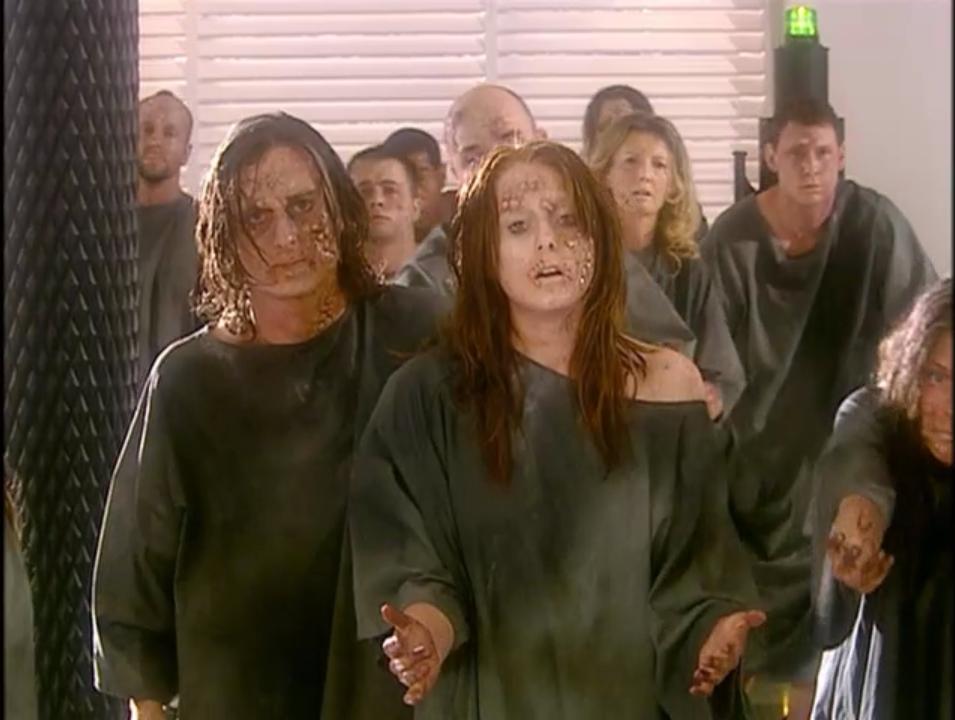
  • I love the Doctor's solution to the problem.  It doesn't make any sense, sure, but the idea is so perfect that I could care less.

    Only the Doctor would save everyone from zombies by healing the zombies.

  • The description of the Doctor as a "lonely god" is I guess sort of accurate, depending on your interpretation of those words, and it is a lovely phrase, but actually having a character say it to his face is overdoing it.
  •   The Doctor's reaction when the possessed Rose kisses him couldn't be more perfect.

Tuesday, April 5, 2011

Remembrance of the Daleks

[1988, Season 25, Serial 1]


Remembrance of the Daleks came at a desperate time for Doctor Who.  Season 22 was, even by this show's standards, highly uneven and had hugely mixed reactions.  About this time, BBC brass apparently decided that Science Fiction was a blight on civilized society.  The show was given an 18-month hiatus and had its season length chopped in half.  The production team responded with the hugely ambitious Trial of a Timelord, which has many good points but builds to an astoundingly anticlimactic conclusion, and resulted in Eric Saward resigning from his post as script editor and angrily criticizing JNT in the media.  Then the Michael Grade unceremoniously fired Colin Baker and cruelly forced John Nathan-Turner to tell Baker he was fired, and then reneged on the deal he had made with JNT.  The next season was thrown together at the last minute, with a new Doctor who was totally lost, an undeveloped and unpopular companion inhereted from Trial, and no script editor.

In a surprise move, Season 24 sucked.  Horribly.  Fourteen episodes, four stories, none of them good, only two of them even watchable.  Still, by the end of the season, things were looking up.  Delta and the Bannermen and Dragonfire, while very, very flawed, showed hints of improvement.  Sylvester McCoy got a couple of good scenes between the two serials, and showed some potential in those scenes.  Bonnie Langford's ill-fated Mel got a little good material before be written out as abruptly as she came in, but her replacement was promising.  Ace was a bit long on then-current teen slang, and Sophie Aldred's performance a bit rough, but Aldred's personality was appealing, and Ace's background and basic sketch was intriguing.  Finally, the production had gone from the ugly-looking Time and the Rani and the appallingly cheap Paradise Towers to a pretty good-looking and well produced finale in Dragonfire.

This doesn't have anything to do with that.  I just wanted this pic somewhere.

But even with all that promise, Remembrance of the Daleks is a remarkable success.  Every hint of quality form the previous season is seized, but it goes far beyond that.  In the history of Doctor Who, Remembrance is one of the most perfectly-paced stories, and one of the most exciting.  It's a wild, rolicking ride full of action, humor, and character, and it ends with a terrific climax.  Most of all, its vision of the Doctor is one of the most intriguing variations on the enigmatic time traveler since his inception.

Also, Ace is awesome.

I mentioned in my review of Earthshock that the pacing felt much faster and tighter than usual, but this is something else entirely.  Earthshock mostly feels faster because it's surrounded by quiet, thoughtful stuff like Castrovalva and Kinda.  Where Earthshock felt action-packed, Remembrance actually is.  It's actually better paced than most modern episodes.  Not necessarily faster, but better; it's always moving forward, always doing stuff, but it knows when to slow down and rest for a moment.  It's paced better than most movies.  It may seem like a minor thing on the surface, but perfect pacing in film and television is exceedingly rare.


Part of it is Andrew Morgan's direction.  His previous Who story was Time and the Rani, which is a legitimate contender for worst Doctor Who story ever, but I will give him credit: he gave the serial visual flair and a wild energy.  There was nothing he could do to overcome the abominable script and production problems.  Here, with a good script and more confident leading actor, he knocks it out of the ballpark.  Tragically, because he went over budget by 13,000 pounds, he was not considered for directing future installments of the show.  It's too bad; this is one of the best-looking stories in the entire classic run.  It's not the flashiest-looking, but it belies its limited budget and captures the early '60s superbly without drawing attention to itself.


Writer Ben Aaronivitch and script editor Andrew Cartmel have a great take on Doctor Who.  There's a scene in the story where the Doctor has a quiet dialogue in a cafe with the server played by Joseph Marcell (Jeffrey the butler on Fresh Prince of Bel-Air).  It's a wonderful little conversation as the Doctor weighs the nature of decisions, but it's also a start to Cartmel's vision of the Doctor: the great wanderer finally taking control of his destiny.  He's no longer aimless traveling: he moves with a purpose, bending the universe to his will, attacking and destroying his enemies rather than waiting to stumble into an encounter, reshaping his companion.


On the surface, it makes him more actively heroic - he looks for villainy to thwart.  But the Doctor has a darkly manipulative side, and always has.  So it's not enough to stop evil: he wants to get evil to destroy itself.  [SPOILERS] The climax of Remembrance of the Daleks isn't just checkmate; the Doctor tricks the Daleks into destroying the entire solar system in which their home planet of Skaro resides. [END SPOILERS] It's an unusual and fascinating take on the character, making him new and mysterious again.


McCoy, finally given good material, takes the role and runs with it.  He's wonderful in the quieter moments, as he always was, and his blustering is great.  But his darker side is terrific.  The scene where he coldly talks a Dalek into blowing itself up is a great concept anyway, but McCoy makes it really gripping.

His teaming up with Ace only adds to the fun of the story.  Sophie Aldred has none of the roughness she showed in her first episode, and she's just a blast.  Ace is one of my favorite companions, and she shows why throughout this episode.  Despite her fanciful origins, she is a grounded, credible character; her emotions and struggles are spot-on for a teenager growing up, but they're also wisely underplayed, and her surface toughness and humor lead her.  Also, she makes her own explosives, just because she likes to.


She gets a lot to do in this story, like beat up on the evil Ratcliffe, blow up Daleks with anti-tank rockets, jump through windows, and is just generally be about twenty different kinds of awesome.  She also gets a nice character arc where she falls for a guy who doesn't turn out to be who she thinks.


Aldred and McCoy work together very well; it's the warmest and most enjoyable Doctor-companion relationship since Four and Romana.  There's also some darker stuff in their relationship, too, with the Doctor manipulating even his companion, but that mostly shows up in later stories.  Here, it's mostly just a good partnership, but the beginnings of it are here, as he refuses to let her in on his plan for no real reason, just because he prefers to keep it to himself.  It's an intriguing dynamic, and it only gets more interesting from here.


Aaronovitch fills the story with great supporting characters.  Dr. Jensen and Allison are a double act worthy of Robert Holmes.


Group Captain Gilmore is nicely drawn - antagonistic with the Doctor on occasion, and sometimes pig-headed, but a competent man nonetheless.  He's reminiscent of the Brigadier in his glory days, but also a distinct personality from the Brig.


As for the villains, there's several human villains, all interesting and full of personality, but Aaronivitch doesn't let them steal the stage from the titular bad guys, and the Daleks are awesome here.  Not scary, but they don't need to be: they're fun, threatening villains able to do genuine damage and, thankfully, never stupid or annoying.  It's a terrific story for the Doctor's best bad guys.  Aaronovitch manages to add some nice twists and little ideas - the Special Weapons Dalek is just awesome, and really needs to show up again.  Davros shows up briefly because Terry Nation insisted that he always show up, but Aaronovitch handles him well, keeping him hidden until the last ten minutes and pulling a nice trick about what exactly he's doing during the story.  Terry Malloy is as good as ever in his one scene, and Davros has good dialogue.  He's not at his Genesis brilliance, of course, but since the story doesn't revolve around him, and as his scene is itself pretty terrific, he works very nicely.


Also, we actually see them hover for the first time.


But the most memorable villain is probably the little school girl mentally possessed by the Daleks.  They need a human child to add some imagination to their strategies as their computers can't move forward, and the possessed girl is a genuinely creepy notion.


The dialogue is among the best non-Holmes dialogue in the show.  It's full of funny lines, but also manages to be dramatic, mystical, or poetic when needed.  The script is also filled with imaginative ideas and notions; the hand of Omega is the best of these, but they show up throughout.

Remembrance is one of my favorite stories, and unlike many of my others, it's so much fun and so fast-paced that it has remarkable replay value.  Despite an entire season preceding it, it's the true start of McCoy's era, and it's a knockout.


ACE: We did good, didn't we, Professor?
DOCTOR: Time will tell, Ace.  Time will tell.  It always does.


RATING:

* * * *


  • For Whovians trying to introduce people to Old Who, this is one of the best places to start, thanks to its pacing.  It's especially useful for people like my sister who are allergic to anything filmed before their birth.
  • They really should have let Aldred keep her hair down more often: she's a lovely girl anyway, but she's gorgeous when given the chance.


  • Keff McCullough gets a lot of flack for his Doctor Who scores, and deserves a lot of it - his obtrusive, obnoxious mess of synthesized chaos pretty much single-handed brought Battlefield down half a star or more in quality.  But I can't complain about his Remembrance music; the action stuff is thrilling and dramatic, the music-box stuff for the girl adds a lot to her creepiness, and the other incidental music is very competent and effective.  Also, I'll go ahead and go on record now and say that, while it's not my favorite, I do like his version of the title theme.
  • I just want to mention the Special Weapons Dalek one more time.  Man, that thing rocks.  


    Thursday, March 31, 2011

    Earthshock

    [1982, Season 19, Serial 6]


    Spoilers, I guess.  This is one of the most famous of all Doctor Who stories, particularly for two elements - its villains and its ending, and it is, of course, those aspects that everyone talks about.  If, by some chance, you haven't watched Earthshock and don't know either the identity of the antagonists or the finale of the story, it's worth trying to see it without knowing anything in advance.  The first episode is carefully constructed to avoid the identity of the villains, and the ending will have a much greater impact if you don't know it ahead of time.  Of course, it's near impossible to avoid those, but hey, just in case you're that one person who is unfamiliar with it, this is one of the most important Doctor Who stories, and in most ways an excellent one, and has two strong surprises.

    You have been warned.

    With Earthshock, producer John Nathan-Turner, writer Eric Saward, and director Peter Grimwade set out a hugely ambitious goal: to essentially make a spectacular sci-fi action movie on a few hundred thousand bucks and six days of filming.  And, amazingly, they pretty much pulled it off.

    Earthshock doesn't feel like most other Doctor Who stories from its era.  It's much tighter and more quickly paced, first of all.  Doctor Who tends to be a bit slower, which is generally fine, as that allows for more characterization and world-building.  But having something so taut and thrilling particularly in a season with quiet stories like Kinda and Black Orchid makes a huge impact.  After the first episode, which is an excellent piece of suspense-building, the story rarely slows down; even scenes without violence are tense with the omnipresent threat of violence.  There's not as much action as there seems to be, but the intense feeling of constant action is what counts.

    The first episode doesn't give away the villains until the final two shots; in the meantime, we're stuck in claustrophobic caves, alternating between the TARDIS crew and a group of soldiers finding their body counts steadily increasing as they look for missing comrades.  These are atmospheric, eerie scenes, particularly when the characters run across the remains of some of their fellows reduced to horrific puddles of liquids.


    After some searching, they discover the culprits: mysterious black androids.  These are simple but creepy creations, and add even more to the escalating suspense of the story, but they're just a decoy to keep us busy until the real villains appear:


    Part of the intensity comes from Saward's portrayal of the Cybermen.  It's easy to criticize where he failed: he gives them none of the overriding creepiness of the central concept, of humans who have essentially replaced their entire beings with robotics.  Nor does he make them emotionless; as he points out, it's very, very difficult to make conflict dramatic and interesting when the antogonist lacks emotion, and while it isn't impossible, Saward goes for a different approach.


    But what he gets absolutely, stunningly right is making them genuinely threatening, more threatening than perhaps they've ever been.  They may not have the elements that make them really unique in place, but taken simply as unstoppable killers, they're truly frightening.  Sure, they could be any overly emotional robotic army, but that doesn't make them any less threatening.  These are violent, vicious metal creatures intent on and capable of all manner of murderous assaults.

    Their redesign does them credit, as well.  In many past appearances, they looked cheap and silly; here, they look much more convincing than before.  JNT's concept of their mouths being semi-visible does give the one indication of their former humanity that works.


    David Banks' performance as the Cyber Leader adds a lot to their menace.  Saward's dialogue for him is silly and over-the-top, but Banks plays the hell out of every word, and exudes power and evil.

    Saward structures the story superbly, keeping things constantly moving and filling the story with action and incident.  He also does a good job giving Davison strong material as the Doctor; good lines, nice touches of eccentricity, and an awesome scene where he gets a Cyberman literally stuck inside the atomic structure of a door.

    "I want to announce my PRESENCE!  And see what the reaction is."


    Adric gets some of the best material he ever got.  He had an unfortunate run of stories where he was more a hindrance than a help, and he can easily get annoying, but here, he's at his best: a kid trying as hard as he can to really be helpful.  He's also a lot less obnoxious than usual, and is actually rather likable.  Matthew Waterhouse is pretty appealing with material this solid.  And it's a good thing, too, because there's a real payoff for all that...


    Tegan is also well used.  Early on, of course, she mostly just complains and such, but this is the story where she finally decides to be more than, as she so accurately describes, "a mouth on legs," and jumps into the fray, picks up a gun, and starts blasting the hell out of the Cybermen.  It's the height of her character.


    For all the material he gives to the lesser companions, though, Saward, drops the ball on the useful one.  Early on, Nyssa is both cool and kind-hearted, but after about an episode and a half, Saward can't think of anything else to do with her (including, I don't know, give her a gun, too?), and just sticks her in the TARDIS doing nothing for the last two-thirds of the story.  That's sort of the problem with having three companions; unless you're extremely clever, one of them is going to get shunted to the side.  Of course, in the '60s, they usually stuck Susan to the side, which worked out just fine since she was the least helpful.  For some odd reason, though, in the early 80s, it's Nyssa who gets screwed over more than anyone despite actually being far and away the best companion of the group.  That said, she does get a few good moments here and there, including a good moment at the end.

    It's mostly just this, though.


    Still, that aside, Saward creates a gripping piece of episodic television, ramped to full power by Peter Grimwade's direction.  The action is well-directed, the atmosphere extremely tense, and the production vastly more expensive-looking than it actually is.


    Davison is predictably excellent.  He's never anything less than terrific in the role, always pouring everything he has into it.  Davison makes his bad lines good, his good lines great, and his great lines works of wonder. 

    Waterhouse, again, is unusually good.  Janet Fielding is at her zenith as Tegan.  Sarah Sutton... well, her material's pretty lousy.  She's good in the first episode, where she gets to do stuff.  She's pretty flat in the rest, but you really can't blame her. 

    The supporting actors generally do good jobs. Beryl Reid is a bizarre choice for the role of a hard-nosed spaceship captain, but she gives such a good performance it's hard not to have fun.


    The story rockets along through its second and third episodes, with successively awesome cliffhangers.  I've said before and I'll say it again, Cybermen make for terrific cliffhangers.  The fourth episode slows just a bit on the action for the sake of tense stand-offs.  The conflict between the Doctor and the Cyber Leader is melodrama slammed across with conviction.


    And then, of course, there's the ending, which finishes the story with a tremendous emotional punch.  Adric's death is superbly handled by Saward: it's heroic, yes, but it also comes from Adric's personality, both good and bad.  He's self-absorbed and invicible-feeling, like any teenager, and is, of course, a genius at math.  And he wants desperately to be helpful.  All these lead to him making a fateful decision that, ultimately, leads to that final tragic moment.

    All in all, Earthshock is a gripping, thrilling, horrifying, and ultimately powerful thrill ride both dramatic and exciting, and earns its place as a Doctor Who classic.


    ... but even for Doctor Who, there are a lot of plot holes.  These aren't too noticeable until the last episode, when the overall plot is revealed, but even a moments thought and the entire story falls to pieces.  If the Cyberman could sneak a bomb onto Earth without it being noticed for weeks, why would their back-up plan be such a ridiculously convoluted scheme to steal a freighter for a suicide bombing?  The cliffhanger at the end of episode 3 is tremendous... but why would they put an army of ten thousand Cybermen on a suicide bomb?

    Once it's all out in the open, the plotting is completely incoherent.  It's like Saward dashed off an awesome rough draft, and then decided not to read over it or even spell-check it, probably.

    My heart tells me that this is a terrific yarn, full of drama and action, and one of the great Doctor Who stories.  My brain tells me it's 90 minutes of incoherent, senseless fury, done with low-budget style.  I guess, in the end, I'm listening to my heart and saying this is great stuff, but not without some massive flaws.

     RATING:

    * * * ½

    • The alternate CGI effects on the DVD are brilliant; they fit in so well you wouldn't even know they were there if you hadn't seen the original versions.  The laser beams are vastly improved, but still look like the product of 80s television.  But the big difference is during the climax, as the freighter hurtles toward the Yucatan.  First off, it actually is the Yucatan.  But it's much better than that: in the original, we just saw a quick model shot of the ship blowing up.  Here, we see it falling toward the earth and the giant explosion that ensues.  The Earth looks very similar to the original, and the effects honestly don't look like anything that couldn't have been accomplished in 1982 with just a little more time and money.  For any of the CGI alternate effects that I complain about, I hold these ones in the highest regard.
      
     
    • Okay, one thing I'm really not clear on: why, exactly, does the freighter fly back in time?  There's so little technobable explanation that the actual reason seems kind of in the air.  I'm pretty sure that it's the Doctor himself who sets all this up, for several reasons.  First, it's way, way too big a coincidence for the ship to just happen to travel back to the very conversation the characters were having at the beginning.  Second, the Doctor really does seem to have a plan going, and while it doesn't go perfectly, I'm pretty sure from Davison's performance and the way the scene is set up that it really is the Doctor himself turning the Freighter into the K-T Extinction Event.  Third, otherwise it just doesn't make any sense.  But the thing is, it's never explicitly stated, and this isn't a script terribly strong on subtlety.  I like my theory a lot more than anything else, but I do wonder if it is just me throwing a theory where it doesn't belong.

    Sunday, March 27, 2011

    The Hand of Fear

    [1976, Season 14, Serial 2]

    Eldrad must live!


    The TARDIS lands in a quarry.


    No, really a quarry, not a quarry pretending to be a distant planet.  Awesome.

    The Hand of Fear is the final regular adventure for Sarah Jane Smith.  It's clear right from the beginning how far she's come.  Her relationship with the Doctor is totally smooth and relaxed; their jokes flow completely out of affection, not confict; and even when they do argue angrily, it comes from the depth of their relationship.  But more telling is Sarah's costume:


    She's been traveling with the Doctor so long that she has completely lost touch with reality.  No more smart business suits or pretty dresses; it's pure self-expression - and the self-expression of a devil-may-care wanderer out for nothing in the universe except fun.

    Sladen was wonderful from the very beginning, but her performances have actually improved over the years.  For comparison, look at the scene in The Time Warrior when she's hypnotized.  It's a solid, convincing portrayal.  Then look at her similar scenes in Hand of Fear: her possession scenes are genuinely unnerving and creepy.


    Sladen gives Sarah such boundless joy, mirth, and humanity that only a grinch could fail to love her.

    The relationship between the Doctor and Sarah is the best Doctor/companion relationship ever, and will remain so.  Even though she's a human, he treats her as a total equal - and she earns it.  There are unacknowledged hints of love here, but they remain unrequited.  Still, their friendship is simply wonderful.  Her sense of humor and adventure match his perfectly; she also shares his eternal sense of wonder at the universe.  When he needs to be taken down a notch for his smugness or immaturity, she does so with great humor.  Of course, they argue like any friends do, but deep down is pure affection.  There's a lovely moment when the Doctor walks by Sarah's hospital room and flips around the "Do Not Disturb" sign to face out, and smiles at his friend getting rest and peace.


    One of their finest scenes comes in episode three, when the Doctor, characteristically, tell her to stay behind for her safety, and she, equally characteristically, totally ignores him and catches up.


    Sarah: I worry about you.  Anyway, who found that thing?
    Doctor: You did.
    Sarah: Right.  So, I'm involved...  And besides, I'm from Earth, and you're not.
    Doctor: That's true.
    Sarah: Exactly.
    Doctor: Yes, but...
    Sarah: Ah, but what?
    Doctor: I worry about you!
    Sarah: So, be careful!
    Doctor: We'll both be careful.
    Sarah: Fine.


    At the end of the serial, after the story has been wrapped up, they have an argument, which I imagine happens quite regularly, and she pretends she's going to get off immediately, while he ignores her various insults and threats (which I also imagine happens quite regularly).  But then he gets something he didn't expect - a summons to Gallifrey, his homeworld.  Outsiders aren't allowed there; he can't take her with him.  So he tells her he has to leave her.  Sladen and Baker play this scene brilliantly; it's incredibly sad and moving, all the more so because neither of them cry; in character, they try to come to terms with their separation, and really can't, but go through with it anyway.


    Even here, there are moments of gentle humor, coming from these two characters trying to deal with this.  It's a wonderful finale and as good an exit as any companion could ever get.


    There's also a hint that there's something more to the Doctor leaving her behind, which Sarah Jane's reappearance in School Reunion thirty years later confirms: the summons to Gallifrey isn't alone what makes him leave her behind.  He leaves her behind because he loves her, and he can't stand what that means: he's a Time Lord who, as he once said, "walks in eternity," and doesn't really die; he simply regenerates and moves on.  Even here, he's over 700 years old, and will live for hundreds or thousands more years.  Sarah has less than a single century.  She'll grow old and die, while he remains the same.  It's something he can't bear, with her more than anyone else.  When he leaves her behind, it's his final expression of both love and a sort of selfishness.  He says he'll return for her, but he never really does.  They meet again, of course, but not because he was looking for her; she was looking for him, and after thirty years, managed to find him.  But that's another story, another quite wonderful story to follow up this lovely yarn.

    But even without that wistful, moving coda, The Hand of Fear would be an excellent addition to the series.  It's a beautifully-structured story, opening with a bang as the quarry literally explodes.


    Buried in the rubble, Sarah grabs onto a strange hand, at which point she screams and falls unconscious.


    The Doctor, along with a fellow scientist, Dr. Carter (Rex Robinson), examine the hand and find that despite being buried in the strata for 150 million years, it's alive - but it's not a carbon-based lifeform: it's silicone-based.  I should make a sidenote here about just how great Tom is throughout this story.  When he plays things seriously, it's truly dead serious, and absolutely riveting.  When he has comic moments, he plays them perfectly.  This is the Fourth Doctor at his zenith.


    Meanwhile, a possessed Sarah flees the hospital and heads to the nearest nuclear power plant, where she places the hand near the radioactive core, exposing both her and the hand to the radiation.  And the hand starts using the radiation to renew itself into a complete body, while Sarah sits quietly by the core and the station begins to go into shutdown from the interference.  The Doctor rushes to the hospital, desperate to save her... and figure out just what that hand really is.

     Besides the hand and its eventual body, there are only two major supporting characters - Dr. Carter and Professor Watson (Glyn Houston), the head of the nuclear plant.  Fortunately, both of them are superb.  Robinson makes Carter an intelligent and likable character in only a few minute of screentime, making his possession and eventual fate far more gripping than it would otherwise have been.


    But it's Houston who really stands out.  The role could have come across as a total cliche - the authority figure stupidly standing in the way of the hero.  The writers, Bob Baker and Dave Martin, avoid this: while Professor Watson doesn't always help the Doctor, he's intelligent enough to work with him when it makes sense, and when he does work against the Doctor, it's understandable from his point of view.  But the character's centerpiece is a moment in the second episode where, believing the reactor is soon to meltdown and that he will very likely die soon, he calls his wife to say goodbye.  Touchingly, he doesn't tell her what's happening, just calls as though it's a casual conversation saying he'll be late for work.  Houston plays the scene perfectly, resisting the urge to play it for melodrama and underplaying the scene beautifully.  It's a genuinely moving sequence.  He's every bit as good in his final scene, where he has to some extent snapped from the pressures of all the insane things going on around him, and yet holds it somewhat together, entirely in character.  It's a really terrific performance.


    It's also a very well-produced serial.  During the Hinchcliffe/Holmes era, many of the stories look and feel more like modestly-budgeted films rather than a low-budget TV show, and this is no exception.  The location filming in the power plant adds tremendous scale to the story:


    But the studio sets are excellent as well, completely convincing as both a hospital and as the smaller rooms of the plant.  The otherworldly sets of Kastria are atmospheric and work well, though they aren't quite as strong as the earthbound scenes.

    The structure and pacing are superb.  The first episode builds its mysteries and ideas carefully, interweaving the intriguing notions like a silicon-based lifeform with the creepy possession scenes.  The second episode doubles the pace as the danger increases.  And then, ten minutes into the third episode and 2/3 of the way through the story, we finally meet the antagonist, Edrad.

    "Can this be the form of the creatures who have found me and now seek to destroy me?"

    Judith Paris' performance as Eldrad is astonishing: she seems truly, completely alien in every aspect, yet elegant and even somehow seductive.  Her voice is unforgettable.  But she also has a lot to work with.  It helps that we have to wait an hour to actually meet her, of course, but she absolutely pays off the build-up.  Further, Baker and Martin make her a genuinely interesting character; though she's certainly the antagonist and her actions do result in a pair of deaths, it's highly ambiguous just how evil she actually is.  She may be more oblivious than malevolent; after all, she also spares lives and doesn't seem to desire the killing of the human race.  It makes her all the more mysterious and creepy, and Paris plays all this to the hilt.  And the makeup and costuming finishes the character, making her one of the finest villains of the entire series, and maybe the best one to only appear once.


    Or at least she is until the climax, when everything falls apart.  They return Eldrad to Kastria, the Doctor reasoning that whatever her moral position, she's better there than on Earth, and it'll be far easier to deal with her in that environment.  They find, however, that their pathway has been booby-trapped, and Eldrad is badly wounded.  They bring her to a chamber where she is apparently to be renewed again, but the Doctor appears to kill her.

    Up until this point, it's a brilliant story, and it's really too bad the next ten minutes sink so low.  Bob Baker and Dave Martin come up with probably the least interesting and least satisfying way to wrap up the story that could conceivably have worked in any way.  More importantly, Eldrad returns to her regular form, which is apparently that of a male.  Unfortunately, despite his stunning voice, Stephen Thorne isn't anywhere near as interesting as the male Edrad.  Much of that is Baker and Martin, though, who reduce her/him from a complex, morally ambiguous, and eerily intelligent antagonist to a ranting, monologuing bad guy who's just evil without anything resembling shading or even interest.  The finale is a dull, disappointing conclusion to an otherwise great yarn.

    But after that, of course, is Sarah's goodbye, and the story not only returns to greatness, but elevates itself to another level entirely.  The involving science fiction mystery has become the gripping thriller, which has become the moving drama of the pain of goodbye, tempered by the memories of joy and happiness.

    Farewell, Sarah Jane Smith.


    RATING:

    * * * ½