Saturday, July 28, 2012

Torchwood: Day One

Jack: "We all make mistakes.  Get over it."

If the first episode of a show is about introducing what the show is and who the characters are, the second episode is about showing off what this shiny new show can really do.  We know the characters, we get the premise, we slogged through the exposition.  Now we can really get down to business.  So what sort of program do we have?

The Torchwood team investigates a meteorite strike that releases a gaseous creature who feeds on orgasmic energy.  So, naturally, the gas inhabits a young woman and starts sexing men to death.

Which is the sort of thing you'd expect from a Cinemax sci-fi show, but Chris Chibnall approaches it from the right directions: he focuses on the emotions of the possessed girl, Carys.  Her confusion and loneliness after her boyfriend leaves her drives her under the power of the alien being to embrace its power and later to use it against her ex.  It's an intelligent way to make it an actual story.


Except Carys, for all Sara Lloyd-Gregory's impassioned acting, never becomes a character defined beyond "girl who just got dumped."  She gets in a nice line about that - "I wish I was dead.  No, I wish you were dead.  Call me back."  But there's nothing else to her, keeping us from actually feeling the emotional roller-coaster she goes through.

The episode would still basically work, though, as long as the stuff with the Torchwood team itself was solid.  Again, Chibnall's underlying idea is an old but solid-enough concept: Gwen saves Carys by understanding who she is as a person instead of treating her as just another case, like the others do.  But his writing is completely ham-fisted, as though he doesn't trust us to understand what's going on.  He shows how Gwen is still connected to humanity by basically just giving Gwen and Jack a couple of speeches saying exactly that, and then having her tape up a bunch of baby pictures of Carys to remind everyone that she's a person


Which might be somewhat forgivable if Chibnall got it all basically right, but other than fitting Gwen into the team because she's the only one still connected to humanity, he pretty much fails to make the team compelling even on a basic level.  Gwen comes off as a pretty ordinary heroine.  Owen continues to be an incompetent ass.  Toshiko and Ianto can't have a dozen lines between them, none of which are remotely interesting.

But it's Jack who suffers most from Chibnoll's pen.  One of the things that made Jack interesting in the first place was his completely uninhibited pansexual promiscuity - he was even a little shocking to Rose, who comes off as pretty sexually liberated herself.  But if every character is a promiscuous pansexual, it kinda takes away the entire point.  And Owen showed himself to be far more so than Jack in the previous episode; while Gwen's makeout session with Carys is apparently motivated by pheromones, she seems pretty comfortable with what almost happened.  When the show finally gets around to remembering that Tosh and Ianto exist, the same goes for them.   Torchwood is so bent on being a sexually liberated show that it fails to show any actual range or depth in its sexuality, making it in a way just as close-minded as the cultural norms it tries so hard to upend.

Even with that in mind, Jack should still be a cool antihero for us to follow.  But his actions here don't speak well for him as the Torchwood leader.  He sends brand-new team member Gwen to interrogate a murderous prisoner completely unsupervised or even observed.  Even after the events of Everything Changes, he can't keep Owen's paws off the alien tech, nor does he do anything about his behavior toward Gwen, which is clearly harassment.  Harassment can be difficult to define sometimes, but Owen's clearly way, way over even a somewhat nebulous line.  And Owen's harassing Gwen directly causes the events of this story.  Jack either doesn't notice or doesn't care.


And then there's the whole business with the hand in the jar, which is not only Anthony Perkins-level creepy if you know where the hand came from, but leads to Jack letting the murderous alien get away because it threatens to harm a dismembered hand.  And his strategy for getting her to back down?  "That's valuable to no one except me!"  That's gotta be the single worst negotiation ever.

All in all, Jack is a portrait of an incompetent leader whose team actually makes things worse, then sloppily cleans up their own messes only after several deaths.  It's a waste of a good character and a charismatic actor.  I love Jack on Doctor Who, but here, the only things he's good at are standing in dramatic poses and dying.

Chibnall's plotting is pretty sloppy, too.  After getting captured, possessed Carys secrets insane pheromones that lure Owen in and then doesn't have sex with him or kill him because... he's one of the main characters, I guess?  I know she's desperate to escape, but she's also starving and insane, and it's literally the only way she'll survive.  (also, where did the handcuffs come from?) It just seems like a cheap contrivance to make jokes about a naked dude.  Which might be forgivable if they were really, really clever jokes, but they're incredibly lazy.  ("Are you all right now, or are you still feeling a bit of a cock?" is really the best they could come up with?)

The details, in general, aren't well thought out.  Carys secrets pheromones that attract woman, but her mating doesn't work with them?  Even though she gets her charge from "orgasmic energy"?

Finally, the tone never really clicks.  Parts of it are trying to be a fun romp (and failing, mostly because of the weak characterizations).  Other parts are going for an X-Files-ish serious sci-fi yarn both creepy and sad (and failing for largely the same reason).  In all, it's a mess.  Without particularly competent characters or interesting dialogue, the lazy, cliched plotting thuds along pretty uninterestingly.  It takes a Skinemax premise, approaches it from fundamentally the right angle to make it a compelling story, and still ends up as a dull, self-serious softcore porn without the actual porn.

It does have very strong acting in its favor, both from the regulars and guest star Gregory, but there are good shows with that.  It's obviously a very low-budget show, but it uses what little money it has wisely, focusing on good actors and making the important effects - in this case, the gaseous form of the alien - really good.  But without good storytelling, those are utterly wasted.  If this is the best the showrunner can do to showcase what will make Torchwood cool and interesting and unique, we're in trouble.


RATING:

* *


SIDENOTES:

  • Owen complains “The amateurs got here before us.”  Having seen Owen’s contributions to the rest of the season, that’s absolutely hilarious.
  • Owen's harassment causes Gwen to release the alien.  After the plot of Everything Changes also came directly out of the actions of the Torchwood team, we might as well start a counter:
    • Number of plots directly caused by Torchwood’s incompetence: 2 out of 2.
    • Number of Torchwood Incompetence Plots in which Owen’s douchbaggery is at fault: 1 out of 2.
  • How does Gwen get cell reception in the Hub's Silence of the Lambs prison?
  • Good Jack line: "You know, strictly speaking, throttling the staff is my job."

Sunday, June 24, 2012

Torchwood: Everything Changes


Pilot episodes are hard.  You have a very short amount of time to introduce the characters, build the world and mythology well enough to get the premise across without getting bogged down in details and exposition, and somehow find time to tell a compelling, self-contained story.  There are a handful of shows that actually did open with a brilliant first episode - The X-Files comes to mind, and, oh yeah, Doctor Who - but it's usually a struggle to actually pull all that together.  Even shows that ended up being really good - say, Dollhouse - start on the wrong foot.  Many shows opt to make it a as a 60-minute or 90-minute special, which helps a little, but still usually results in a deeply flawed program.

And honestly, rewatching Everything Changes, I'm going to have to take back what I said in 42 about Torchwood's first season only having one good episode.  While this has its problems, it's a perfectly respectable pilot with some good touches.


The best and most important element is the heroine, Gwen Cooper.  Gwen has everything you need for a Sci-Fi heroine - she's brave, resourceful, clever, human, and played by an actress with tremendous personality.  Eve Myles is just wonderful, and makes Gwen the perfect center for the show.

Jack Harkness doesn't do too much other than be charmingly mysterious, but John Barrowman plays the charm to the hilt.  And while he doesn't do much in this episode, he's an inspired hero for the show - a charismatic action hero with a dark side.  While it's not dwelt on, Everything Changes gives him a level of depth he never had on Doctor Who, dealing with his immortality and the pain it causes.  He doesn't brood too much, just enough to make it compelling.


Given the show's sexual politics, he's obviously exactly the guy you want, and his moral ambiguity allows the show to attack moral questions in ways most shows wouldn't dare.  As for how those elements actually play out, we'll explore that in Day One and Small Worlds, respectively, but it's a good choice.

The rest of the characterizations are uneven at best, but the actors can't be faulted in the slightest.  Often, it takes a show's cast an entire season or more to fully slip into their roles, however well chosen they were.  But Burn Gorman (Owen), Naoko Mori (Tosh), Gareth David-Lloyd (Ianto), Kai Owen (Rhys), and Tom Price (Andy) all play their characters like they've been doing it for years.  And in some cases, they're way, way ahead of the writers.  Heck, the writing for Ianto doesn't catch up to David-Lloyd until Children of Earth.

But actually looking at them as characters, most of them don't work properly.  Owen is a disaster.  His introductory scene involves him using an alien date-rape drug on a couple, so he's obviously a terrible human being.  It's also unclear exactly how he could contribute to the team, since he actually orders pizza to the top-secret organization under the name "Torchwood".  (in the episode itself, this sounds like it could be sort of a joke, but based on his characterization later, it seems to be serious)

Although Gwen delivering the pizza to sneak in is a nice scene.

He comes off as the sort of incompetent, self-involved jackass who is more likely to cause the end of the world than save it.  Still, he only has a couple short scenes here, and Gorman makes every line of dialogue shine.  As long as he either becomes very useful very fast or is a minor character as he is here, he can't cause much damage to the show.

Tosh... likes computers, I guess?  She barely appears at all, and we don't get any reading on her as a character whatsoever.  (This would be less annoying if the show didn't basically ghettoize her as a glorified extra until episode seven.)  Ianto apparently gets the coffee.  The idea seems to be that his true role is really mysterious or something.  The actual effect is to make us wonder why he's here at all.

Rhys, Gwen's good-natured boyfriend, and PC Andy, her colleague, are both extremely likeable characters, and, quite frankly, I kinda wish they had been on the Torchwood team instead of reduced to occasional guest stars.


The last character, Suzie Costello, played by Indira Varma, is successful in a plot sense but doesn't quite come off in an actual character way.  Like Tosh and Ianto, we don't get any real sense of who she is.  I like it when she fumbles around clumsily and politely in her purse for her gun, but her motivation makes no sense whatsoever.  I mean, really?  There aren’t any murders ever unless she commits them?  I mean, Cardiff is a city of around 350,000 people.  Also, they’re only about 130 miles from London.  There's gotta be a murder scene our top-secret organization the cops know all about can get to in time.

The point of her character is great, though - she's not only introduced as one of the team members, gets her name in the credits, and until the end is treated just like one of the regulars.  It's only at the climax that we learn this "regular" is actually the murderer the heroes are looking for.  And then she kills herself.  Suzie’s guilt and death is a clever twist in the Whedon/Nation tradition, and while it has neither the gut-wrenching emotional punch Whedon would have given it (because we don’t care about her in the slightest, though Indira Varma is stunningly beautiful and a superb actress) nor the ruthless creativity Nation would have used (dude had a serious knack for killing characters imaginatively), it’s still fairly effective at communicating that this show is not joking around.


The plot is extremely functional in a good sense - nothing terribly original or striking, but it's a solid enough foundation that works because Gwen works.  And when a really good scene comes along, everything clicks beautifully.  In particular, the Torchwood team makes the apparently strange move of letting Gwen walk right into their base and introduce themselves and everything they do.  Gwen notes that this probably means she's about to die.  Jack instead gives her his whammy and happily tells her that her memories are wiped.  "When you wake up tomorrow, you’ll have forgotten all about Torchwood.  Worse, still, you’ll have forgotten me.  Which is kinda tragic.” But she proves herself nicely - she's so dedicated and clever that she manages to embed her memories deeply enough that they're triggered again.

And that makes it work.  A lot of the little details don't quite come off - the Weevils are about the most generic aliens ever, Torchwood's actual level of top-secretishness is hilariously inconsistent, the characters constantly saying "Torchwood" like it's the awesomest word ever pretty much accomplishes the opposite, and the scenes where Jack and Gwen stand dramatically on random rooftops for no reason whatsoever are just trying way too hard to look cool.  But the core of the story is Gwen, and she makes it a pretty entertaining start to the show.


RATING:

* * *


SIDENOTES
  • The title theme isn't exactly a make-or-break thing for a show, but a really memorable title sequence and music just adds so much to a show - think Andy Griffith, or The X-Files, or, you know, Doctor Who.  Torchwood starts with a cool underlying sound, but it never actually puts a theme on top of it.  The opening credits are okay but generic.  It's too bad - the actual music for the episode is pretty effective.
  • So, people seriously deluded themselves into believing the events of Christmas Invasion and Doomsday didn’t actually happen, or were some sort of terrorism?  Seriously?  I can understand dismissing Aliens of London, and while it’s a stretch, something like Spearhead From Space at least seems like a coverup, while suspicious, could at least throw people off the Aliens track by having too many confused conspiracy theories out there. 

    But a city-sized spacecraft appears over London and hypnotizes a fourth of the population to stand on the edge of a precipice, and then, a few months later,  there’s an invasion by evil robots (who, presumably, converted hundreds, if not thousands) who then battle a group of murderous alien trashcans, and most of the population convinces themselves these things didn’t happen? SERIOUSLY?  Even in The Invasion, which is a ludicrous stretch, at least everyone was technically asleep for the alien invasion. And here’s the thing: there wasn’t actually a coverup.  Harriet Jones came on air and admitted there were aliens.  Presumably other leaders did the same.

    To be honest, it’s ridiculous in Doctor Who as well, but since we only pop in here every once in a while, it’s not that big a deal since we’re off to Karn next week.  But when the entire show is based in a modern-day earth that dismisses Independence Day actually happening, it's difficult to believe in the world-building.
  • This is supposed to be the "adult" Doctor Who spinoff, but so far, they just use it to toss some swear words in.  That's kinda lowballing the definition of adult.

Friday, June 22, 2012

42

"BURN WITH ME!"


Over the next few weeks, I’m going to review season one of Torchwood.  It’s not gonna be pretty.  It’s not that there aren’t good episodes in there.  There are.

… is.

… one.

… barely.

But still, it does eventually improve in the second season and then goes and makes a pure masterpiece for the third season.  Outside of Children of Earth, I don’t think it ever really lived up to its potential, and in fact usually falls short by a wide margin, and I find it incredibly frustrating for that reason.  But I still kinda like it overall, even though I don’t like the vast majority of individual episodes.  So before I tear it a new one, rest assured, if I survive the experience of re-experiencing the horrors of Cyberwoman, I will one day get around to saying good things about that show.


And that includes Chris Chibnall, who was the lead writer for the first two seasons and was consequently not only responsible for a large portion of what went so wrong (though some of the blame also has to go to Torchwood often bringing out the worst in Russell T. Davies), but wrote some of the worst episodes, including the aforementioned Cyberwoman.  He’s also an intelligent, clever, imaginative writer at his best who, late in the second season, wrote two of the best episodes of that show.  But it’s going to be a long, long, long time before I actually get around to that, so to at least partially balance out the wave of vicious criticism (read: smart-aleck mockery from a so-far failed writer) about to be unleashed, I thought I’d review something he wrote that I actually like.  42 is a good, enjoyable episode of Doctor Who that shows a genuine love for the show and does a few things spectacularly right that Davies’ era doesn’t always pull off.  It does still have its flaws, but even those are vastly overstated.

Probably the most common flaw 42 is accused of is that it’s too derivative of the previous season’s The Impossible Planet / The Satan Pit.  After all, both involve the Doctor and companion separated from the TARDIS, both involving the crew being possessed and then killed off, and both involve not being set on Earth.


Of all the things to accuse 42 of, this is probably the most ridiculous if you watch the classic series.  After all, The Impossible Planet is itself just a variation on the old Hinchcliffe-style “gothic horror story where the Doctor fights a godlike villain” with the added twist of being separated from the TARDIS, which shows up in nearly every Hartnell story of the first two seasons.  The Impossible Planet has many qualities, but it’s every bit as derivative of previous Who stories as 42.

Which really isn’t a major problem – Doctor Who usually relies on standard sci-fi tropes itself.  It’s what you do with those tropes that matters, and while Chibnall uses a few too many standard ideas, he throws them together in a fast-paced, action-packed story with a couple of real dramatic punches.

Most of the reason this feels derivative specifically of Impossible Planet - even though it only uses a couple of the same ordinary tropes - is that Who under RTD is so obsessively Earth-based that this is only the second time in three seasons that the Doctor, an alien with a machine that can take him anywhere in time and space, has actually had an adventure not on or in the immediate vicinity of Earth (or New Earth, which, frankly, is pretty Earthish).  So the fact that it uses some of the same tropes as the only other one like it so far makes it stick out a little more.


The downside of this is an odd lack of imagination in a lot of the stories.  Not that there aren't inspired stories, but there are an awful lot of Evil TV Sets and similarly uninspired ideas.  At this point, in Season 3, the better episodes have been Giant Evil Spider Sits Around and Pretends to be Menacing, Space Rhinos on the Moon, and Traffic Jam in the Future.  And while those are perfectly fine ideas in themselves, they're a little underwhelming in a show that was doing Brains With Eyestalks back in 1964 on an off-day.  Too many RTD-era episodes are oddly forgettable and mediocre despite having good production values, great directors, and a solid group of writers, including at least a couple of geniuses. (to be fair, the back half of Season 3 totally rectifies this)  And a lot of it comes down to a lack of ambition and too few interesting ideas barely filling 45 minutes.

(Moffat's era more often has the opposite problem - too many ideas for 45 minutes, but as much as I've been frustrated with that, I've gotta be honest, I really prefer that between the two.)


Chibnall, however, finds a good balance of ideas for an episode: a setting that's interesting and unusual but not overly complicated; a supporting cast large enough to have a decent body count, but small enough to develop them (which is actually a mixed bag, but it's at least the right number); a couple of terrific set-pieces in the second half of a well-paced story; and one spectacular concept, saved for the last ten minutes.

The set-up is simple - the Doctor and Martha land on a ship that's out of control and hurtling toward a star.  Its shields will give out in 42 minutes.  Which would be enough of a problem if there wasn't a horrific entity possessing the crew and killing them off.

The best thing about Chibnall's script is its ability to raise the stakes.  The central gimmick -the story happens more or less in real time, with the 42 minute time limit for the characters paralleling the length of the episode - forces the story to be efficient and puts the stakes in a solid context.  The supporting characters start dying off pretty quickly, keeping the threat of death near.


But it's the two centerpiece scenes that really drive home the intensity.  The first is a scene where Martha is ejected into space in a tiny escape pod... directly toward the same sun the main ship is hurtling toward.  In the midst of a loud, rousing episode, the sound suddenly cuts to a minimum as Martha suddenly gets a chance to realize that she really is about to die.  She calls her mother and has a deeply emotional conversation while trying desperately not to get emotional.  By dealing with the threat of death so directly and emotionally, the meaning of the episode grows exponentially.


(The entire subplot about Martha's family basically flops around and fails throughout the entirety of Season 3, but for this one scene, it works brilliantly, contrasting her mother's genuine concern with her attempts to get Martha to give real information to the mysterious people she's letting listen in.)

While making the companions actually think about the possibility of dying is probably something that should be done a little more often (not every episode or anything, but occasionally doesn't hurt), Chibnall's most effective trick to raise the tension is something Doctor Who can only do very rarely: he has the Doctor fail to defeat the antagonist and become completely scared... but only after the Doctor confesses that he's terrified.  These two things together are the most frightening trick the show can pull.


And Chibnall does manage to earn the right to actually pull out that one.  The antagonistic creature possessing the crew is actually the sun itself, which is alive.  It's possessing and killing the crew because their ship was killing it by extracting its fuel.  That's a compelling twist in itself, but Chibnall's approach to the crew, and particularly the captian (played by Michelle Collins) - they're a desperate, working-class group illegally scooping energy from the star simply to survive.  And in their efforts to be undetected, they didn't scan for life because who would scan for life on a star?

This is a brilliant addition of complexity - neither side is really the hero or the villain.  Both sides are simply trying to survive.  And between the complex writing and the sheer stunning idea of a living star, it earns the right to possess the Doctor.  And it's an absolutely brilliant scene, showing what an astounding actor David Tennant is.


Which isn't to say the script is perfect or anywhere near it.  First, the characterization of the Doctor is largely off.  His dialogue sounds more like "generic hero" than the Doctor.  In particular, when he's outside the ship trying to save Martha, he almost gives up and says he can't do it, and has to be encouraged onward by one of the humans inside.  It's jarringly unDoctorish.  And Chibnall gives the Doctor one of his ever more tiresome RTD-era tirades about how humans are alternately the greatest species ever to exist and the lowest form of self-serving idiots.  Yes, Tennant is brilliant and covers it as well as he can, but it's still a problem.

And while Chibnall has enough time to develop the small crew of the ship, he never actually does.  The captain is well-written and has a good last scene, but the rest are generic and interchangeable.  Even in the midst of that wonderful scene in the escape pod with Martha, Riley still isn't actually developed.  At the end, when she says goodbye to him, the only difference between him and the other survivor is that he looks slightly different.

His dialogue is uneven in general.  There are good exchanges here and there, but most of the dialogue is forgettable.  And while it's not necessarily a major problem that he uses the ol' "alien killing off the crew one by one" device, it doesn't smooth things over to have a character actually say, "He's killing us off one by one!"

And yet it pretty much gets away with flaws that should have left it forgotten because it pulls out one of Doctor Who's secret weapons: Graeme Harper.  Harper proves he's still Who's greatest director, giving the episode such intensity, energy, and drama that he actually plows right over the flaws, reducing them to minor quibbles.  He makes the "monster" - just a guy with a welding mask - a genuine force of terror.  He gets Murray Gold to deliver one of his best scores of the season, highlighted by a deeply effective use of synthesizers. (frustratingly, Gold's music for the episode doesn't show up on the CD.) Harper makes the most of every image and idea and gets superb performances from every actor.  And you can feel the heat.  If the next two stories - Human Nature and Blink - weren't so spectacularly brilliant and the three-part finale so memorable (however debatable its actual qualities), 42 would probably be remembered as one of the highlights of the season.

Which isn't to say the flaws aren't there.  And the thing is, those flaws all seem pretty easily fixable.  Give the supporting characters some personality on the page, cut a couple of the weaker lines, and make the Doctor's dialogue more Doctorish.  Really, this is one rewrite away from a terrific script.

And that, actually, is pretty defining for Chibnall.  He's got a lot of good ideas and genuine talent.  But like Terry Nation, he desperately needs two thing: a script editor to get him fixing the flaws and a director who can make the most of his ideas, because his scripts tend to feel like pretty good first drafts, not polished final drafts.  And on Torchwood, he's the lead writer.  So all the things that get smoothed out in rewrites - weak characters, inconsistencies, plot holes - don't get noticed.  And while they get pretty serviceable directors in the first season, they let a lot of major mistakes fly.

On Doctor Who, he's got a fantastic group of collaborators to cover for him.  On Torchwood, he's kinda the whole show.  And it's a mess of a show.

But 42 shows that he can write good TV.  And even on Torchwood, sometimes he does.


RATING:

* * * ½


SIDENOTES:

  • One more good thing Chibnall does - he doesn't spend more than minimal time with the crew disbelieving the Doctor.  It's just long enough to be credible, but not enough to slow down the story or make them seem unintelligent.
  • His lack of subtlety - the characters actually saying the tropes out loud, for instance - is another major problem. (and again, the sort of thing that gets smoothed out in good rewrites) But there's one awesomely not-subtle moment that's nicely effective - the annoyed crew member grumbling sarcastically, "Please, kill me now," right before actually getting killed.
  • The effects are just absolutely awesome in this one.  I mean, the sun actually looks pretty much like what you'd expect a living star to look like.  And this came out right around the same time as Danny Boyle's spectacular Sunshine, and it looks just fine right next to it.


Tuesday, June 5, 2012

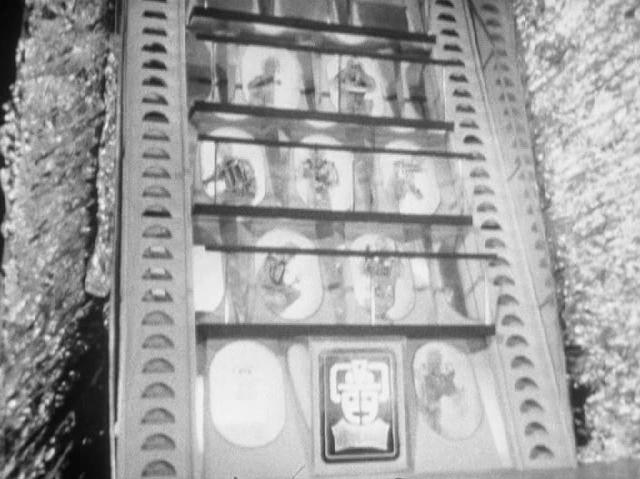
Tomb of the Cybermen


In the years after airing in September 1967, Tomb of the Cybermen built a reputation as one of the great classics of Doctor Who - the scariest story Who ever told, full of colorful characters and frightening concepts. When it was discovered a decade later to be one of the missing serials, junked by the BBC to save space in 1969, its reputation only grew - not only was it one of the greats, it was apparently lost forever. So its rediscovery in 1992 had it heralded as the most sought-after story at last rediscovered. It was quickly released on video... to a somewhat disappointed reputation. The consensus about Tomb changed - it was a great script muddled by a low-budget production. This has lead to a belief in some quarters that the lost episodes are better left undiscovered for fear that their on-screen realization can never be as good as we imagined.


Which is ridiculous. The production is as good as '60s Who gets - vividly atmospheric, memorably designed, and featuring a couple of terrific set-pieces. And there probably isn't a Classic serial with a more effective use of music throughout the story, both stock and original, until Paddy Kingsland's arrival in 1981. No, the problem is that the story is rubbish, which actually should have been obvious long before the video release.

Thursday, May 31, 2012

The Dalek Invasion of Earth


This is one of the big ones.  A sweeping, incredibly ambitious epic centering around the first return of a previous villain - and the villains who put the show on the map.  It takes everything the show learned across the first season and change and then shoots for the moon.  And it comes close enough to hitting it that it deserves to have the word "Classic" thrown at it.  There are a lot of little things wrong with The Dalek Invasion of Earth, but it gets all the big things right - and one above all that makes this the first episode of Doctor Who that truly feels fully like Who.

Tuesday, May 29, 2012

Planet of Giants


Susan: Can you get us back to normal size?
Doctor: Well, of course!  Yes, I'll try.  There's always a chance.

Monday, May 28, 2012

The Reign of Terror

Barbara: What have you done?
Ian: Oh, nothing much.


The Reign of Terror, the final story of Doctor Who's first season, introduces writer Dennis Spooner, who became the script editor for the majority of the second season, and would end up writing The Romans, The Meddling Monk, and the back half of The Daleks Master Plan, as well as contributing to the first episode of Power of the Daleks, becoming one of the best and most important figures in Doctor Who's history.  Which you never would have guessed based on his first Who script.