Okay. If you're reading this, you're really diving into the deep end. Don't worry; it's totally worth it. This truly is an amazing show, and the deeper you go, the more wonders you'll discover.
Classic Who stories all are serials; the episodes are about 25 minutes, and the complete stories are usually 4 episodes. A single story is generally found on DVD in a collection of all the episodes to that story. Because they're both older and serialized, the longer ones can feel really slow if you watch all the episodes at once since they're paced as individual episodes, not a 100 minute movie. It can bet helpful to take a break between episodes.
The first six seasons, from 1963-69, are in black-and-white. Out of the 253 episodes produced in the 1960s, 106 episodes from 27 different serials are missing, destroyed in the '70s to free up storage space before someone realized people might actually want to watch these things again (and home video made it profitable to do so). The audio from all the missing episodes is intact, meaning these episodes can still be experienced through "reconstructions", which take the surviving audio recordings and set them to on-set photos, telesnaps, and any surviving clips. However, it's probably worth saving the missing stories until you're really comfortable with all the regulars appearing in them.
If you've been watching the New Series and want to sample the old series, here's a list of 12 essential stories - one story from each Doctor, representing one of their best, as well as an additional few stories that are must-see serials regardless. There are also a few other suggestion for each Doctor.
William Hartnell - The First Doctor
The First Doctor's early stories play him as a mysterious and often sinister figure; over the course of his first season, he gradually becomes the more heroic figure we know. Hartnell gave the Doctor an extraordinary gentleness and an almost childish sense of humor and wonder underneath the grouchy old man exterior. But this little old man could also be terrifying to his enemies when he wanted to be.
The Aztecs
The first season, naturally, struggles to find its feet, but its highlights are fantastic, and
The Atzecs represents great
Doctor Who early on. Rich characterizations and dialogue in a tightly plotted and paced adventure as the Doctor's companion, Barbara, tries to save the Aztec culture from destruction by turning them away from human sacrifices. But the Doctor insists that they cannot change it, and the High Priest will do anything to keep his power from being taken away.
OTHER STORIES TO WATCH:
The Dalek Invasion of Earth, The Rescue, The Time Meddler
Patrick Troughton - The Second Doctor

Troughton's Doctor was funnier and much sillier than Hartnell's, but he used his clownish mood to hide a staggering intelligence and a brilliantly manipulative nature.
The Mind Robber
The Second Doctor and his companions accidentally stumble into Land of Fiction, where all the characters ever created in Fiction are real, but can only say the words their writers gave them. The TARDIS explodes, leaving them no escape as the Master of the Land of Fiction tries to turn the companions into fiction... and the Doctor into something else entirely. It's even more insane than it sounds.
The Invasion
The Doctor protects near-future Earth from an alliance between a power-mad owner of a technology company and a familiar alien menace revealed halfway in. Fast-paced, thrilling story with a fantastic human villain, great supporting characters, and plenty of action. Two of the eight episodes are missing, but the DVD covers these with surprisingly effective animation.
OTHER STORIES TO WATCH:
Tomb of the Cybermen, The War Games
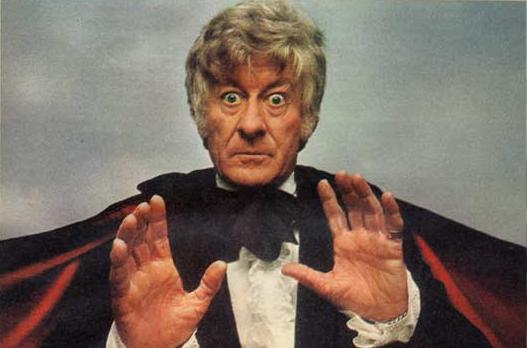
Jon Pertwee - The Third Doctor
Pertwee played the Doctor as a swashbuckling action hero, despite the appearance of a glam, aging dandy. His early stories found him stranded on Earth by the Time Lords after the events of
The War Games. On Earth, he worked somewhat reluctantly with a military organization, UNIT, to fight off alien invasions. In his second season, rival Time Lord The Master, was introduced as his arch nemesis. After
The Three Doctors, his ability to travel in time and space was restored, and he resumed his travels.
Carnival of Monsters
The TARDIS lands on what at first appears to be an early 20th century ship, but when they're attacked by a Plesiosaur, and then begin to relive everything in a loop, it's obvious something insane is afoot. A witty, wildly imaginative yarn driven by colorful characters and highlighted by the Drashigs, one of the greatest classic monsters.
OTHER STORIES TO WATCH:
Spearhead From Space, The Ambassadors of Death, Terror of the Autons, The Curse of Peladon, The Three Doctors, The Time Warrior
Tom Baker - The Fourth Doctor
The bohemian, scarf-wearing, Jelly Baby-consuming Fourth Doctor has long been the most popular and beloved of the Classic Doctors. Numerous American fans began watching his stories on PBS in the 70s and 80s. He played the Doctor for seven seasons, from 1974 - 1981. His early stories tend more toward horror, his later ones toward comedy, and his final season toward intellectual sci-fi.
Genesis of the Daleks
One of the great unquestioned classics of
Who, a dark, terrifying, and powerful epic that belies its low-budget TV origins to deliver a staggering punch even today.
 Pyramids of Mars
The Doctor faces Sutekh, an alien who was once worshipped as an Egyptian god... and who, if released, will unleash his godlike power to destroy all life. A witty script complements an intelligent, complex horror yarn. It also serves as a great showcase for Sarah Jane Smith, rightly the most beloved of the companions.
City of Death
What better way to wash down two dark horror epics than one of the funniest episodes of the show, written by Douglas Adams (of
Hitchhiker's Guide to the Galaxy fame) and including a cameo by John Cleese? A delightful comedy built on a genuinely intriguing story you'd best discover yourself.
OTHER STORIES TO WATCH:
The Brain of Morbius, The Seeds of Doom, The Deadly Assassin, The Ribos Operation, The Pirate Planet, Full Circle
 Peter Davison - The Fifth Doctor
Peter Davison played a thoughtful, patient Doctor, but he was still capable of fighting all manner of monsters and villains. Davison always gave the role everything he had, despite scripts that ranged from sublime to hideous. Despite his efforts, his era is a bit uneven, but it's still a very good show more often than not, and occasionally brilliant.
Kinda or
The Visitation
Choosing a single episode to perfectly explain the Fifth Doctor's era is difficult, not least because about half of his stories are straightforward and normal, and the other half are crazy and experimental. So which one to start with depends on which kind you like more.
If you prefer Doctor Who at it's maddest,
Kinda is a philosophically and thematically rich adventure set in a strange, dreamlike world. It's roughly what you'd expect a David Lynch version of the show to look like.
If, on the other hand, you just want the Doctor fighting off monsters from destroying Earth,
The Visitation has the Doctor and his companions facing down aliens in 1666 London. It's not an interesting story, exactly, but it's nicely-paced, witty, and exciting.
The Caves of Androzani
The Fifth Doctor's last and greatest story - a riveting action yarn that, thanks to tight scripting by Robert Holmes and stunning direction by Graeme Harper, looks and feels like a sci-fi film rather than a little old TV show. The plotting is deliciously complex, the characterizations and dialogue brilliant, and the ending deeply powerful. Peter Davison always gave the role his all, but he was never better.

OTHER STORIES TO WATCH:
Earthshock, Snakedance, Mawdren Undead, Enlightenment
Colin Baker - The Sixth Doctor

Colin Baker's bombastic, unstable, but oddly funny Sixth Doctor at first embraced violence to fight the horrors of the universe. Even when he softened, he was always a darker figure than the Doctor had been since the earliest days. Baker's approach to the Doctor is compelling, but he had an unfortunate scarcity of good stories, and an even more unfortunate costume. In the midst of his first full season, the series was put on hiatus. When it returned, it was with a season half the length of earlier seasons. This season,
Trial of a Time Lord, started as the best Baker's
Who had been, then nose-dived halfway in to the worst of his era. The ratings crashed, hard, and Baker had only 11 stories (if you count
Trial as four distinct stories), of which fewer than half are good. It's a difficult era to love, but there are still good stories and great bits in it.
Vengeance On Varos
Baker shines in
Varos, one of his best stories. It's a flawed and nasty but intelligent and compelling satire of television violence, set on an intriguing world.
OTHER STORIES TO WATCH:
Revelation of the Daleks, Trial of a Time Lord
Sylvester McCoy - The Seventh Doctor
After a rough but steadily improving first season crawling out of the hole
Trial of a Timelord had dug, McCoy's
Who rose to the greatest heights the show had ever reached. The stories were brilliant, his companion, Ace, was the coolest he'd ever had, and at the center, McCoy's Doctor was absolutely fascinating - a master manipulator inside a whimsical clown, pushing the underlying concept of Troughton's Doctor to its limits. Despite the show's resurgent genius, however, the rating never recovered, and the show was quietly cancelled in 1989. But McCoy's short second and third seasons stand as some of the finest storytelling in all of
Who.
Remembrance of the Daleks
As the Daleks converge on 1963 London for some nefarious purpose, the Doctor decides to take the sort of drastic action he usually avoids, to spectacular results. Exciting, fast-paced yarn with wonderful characters and an awesome showing for Ace, the Doctor's final classic companion... and one of the most complex portraits of the Doctor himself at the center of it.
OTHER STORIES TO WATCH:
The Greatest Show In the Galaxy, The Curse of Fenric, Survival


.jpg)