Showing posts with label Neil Cross. Show all posts

Saturday, May 18, 2013

Hide


In the midst of a frustrating season delivering mostly entertaining but deeply flawed episodes, Hide stands as a much-needed reminder of the heights Doctor Who can scale. And it does so in a small, personal story where the stakes are rarely higher than a single life, and never higher than a handful.

And it's a 45-minute story that works beautifully. I think 90 minutes is a more natural fit for this show in general, but for all my problems with individual single-parters, I really have nothing inherently against the format when done well. And it's done very well here - a simple, character-driven story full of atmospheric horror and deeply felt emotion.


Its success lies primarily in its characters and the performances. In a savvy move, writer Neil Cross reflects the Doctor and Clara in the other two characters: Professor Palmer (Dougray Scott, a great actor who, sadly, I always remember as the bad guy in Mission Impossible II), a genius, something of a Renaissance Man, but also a haunted war hero researching the supernatural; and his assistant Emma Grayling (Jessica Raine, who will play Verity Lambert in An Adventure In Space and Time), a compassionate but lonely psychic longing for the Professor.


Setting them as reflections allows for compelling conversation. The Doctor and Palmer, who seems almost like a low-key, human version of the Doctor, discuss what so haunts the Professor: "I didn't mind dying for that cause. It was a very, very fine cause..." but he's horrified at having been forced to send others to their deaths.

DOCTOR: "If you could contact them, what would you say?"
PALMER: "I'd very much like to thank them."

Of course, the Doctor has been haunted throughout New Who by the Time War, but more recently, his torment stems from his companions. As he said in Let's Kill Hitler, when reminded of his most recent companions, he mostly feels guilt. Rose was torn away into another dimension; Martha left because in favor of a (relatively) ordinary life, partly because the Doctor mistreated her; Donna's story, of course, ended in tears; and now, Amy and Rory were taken from him by a brutal time paradox that keeps him forever away. Even knowing they all went on to lead happy lives is little consolation.


Later, when the Doctor takes Clara through the whole history of the Earth (a fantastic scene, by the way), she's stunned. "To you, I haven't even been born yet. And to you, I'm already dead." And while he naturally doesn't quite see it that way, being a Time Lord, it does reside in his mind. It's why so often he simply abandons the companions in a time and place where they'll be happy - that way, somewhere out there, they're always alive. There's something selfish in it - an inability to deal with death and goodbyes. And for an immortal traveling infinity, he'll always have to deal with those. And all this starts to hit home for Clara.

CLARA: To you, I'm a ghost. We're all ghosts to you. We must be nothing."
DOCTOR: "No. You're not that."
CLARA: "Then what are we? What can we possibly be?"
DOCTOR: "You are the only mystery worth solving."

There's tremendous history and an epic power in their conversation - in a way, every farewell from The Dalek Invasion of Earth until now haunts the conversation. But there's also something deeply personal to give it even greater resonance: Clara herself. It's a moment of personal vulnerability we haven't really seen from such an outwardly cock-sure, energetic and apparently brave girl.


Clara spends time talking with Emma, which results in one of the most bizarrely on-the-nose failures of the Bechdel Test ever - while the Doctor and Palmer have a quietly searing discussion brimming with subtext about death and losing comrades, the girls mostly just talk about boys. Still, it's a thoughtfully written conversation, so it's worth looking at on its own merits. As with the Doctor / Palmer conversation reflecting the Doctor's relationship with companions, the Emma / Clara conversation nicely parallels - and contrasts - relationships between the Doctor and his companions. Both Emma and Clara have feelings for their partner, but neither admit it. But Emma warns Clara not to trust the Doctor: "There's a sliver of ice in his heart."

Later, after the Doctor and Clara traverse the Earth's history, Emma senses Clara's torment:

EMMA: What's wrong?
CLARA: Just saw something I wish I hadn't.
EMMA: What did you see?
CLARA: That everything ends.
EMMA: No, not everything. Not love. Not always.

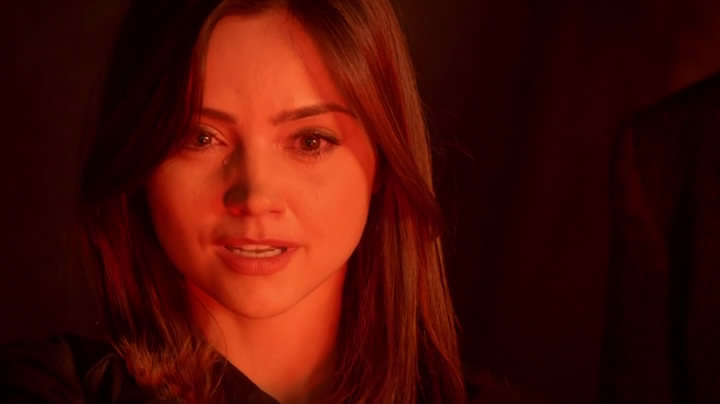
If there's something keeping their conversations from reaching the higher plane the other conversation reaches, it's strangely that Clara's less well-defined than Emma. This episode does more than any other to flesh her out, digging beneath her brash exterior, but she's still a strangely generic companion elevated by a fantastic actress. I do love the stuff about the TARDIS not liking her, but I'm still waiting for her to get the level of development the other New Who companions had by the end of their first adventure. Her fear is nicely explored, though. I particularly like the conversation where the Doctor tries to get her to explore the haunted house, and she refuses until finally telling him to dare her. Even if she's not especially well defined, she's fleshed out nicely for an episode that doesn't really focus on her.

On the other hand, the Doctor is on fire here, getting to be properly Doctorish throughout in a way he rarely does this season. His alien nature comes across well - I love the Doctor going on about how lonely she is right in front of her, totally missing how utterly insensitive it is. His later conversation with Emma right before diving across universes also shines:

EMMA: Doctor? Will it hurt?
DOCTOR: No. Well, yes, probably. A bit. Well, quite a lot. I don't know, it might be agony. To be perfectly honest, I'll be interested to find out.


He also gets plenty of moments of cleverness, humor, and derring-do, particularly in the second half, as he throws himself into the collapsing pocket universe.

Which finally brings around to the story itself, which works beautifully - it's scary, intelligent, and perfectly paced. The ghost stuff never runs out of clever bits to do, and the second half delvers all kinds of adventure and frightening moments. If there's a problem, it's that the ending isn't quite built to properly, but it's still a nice ending that fits Who well. It's probably the best exploration this season of the Doctor's relationship with death, and a nice reinforcement of the general Moffat theme of Love.


And it's what this season really needed. The technical quality has been outstanding, and except for the endlessly dull Cold War, the stories have been interesting, but every season of a TV show needs those standout episodes that fully deliver on the promise of the show - a few great peaks redeem a dozen valleys. Since Asylum of the Daleks, there have been a lot of good episodes, and many flashes of greatness, but no episode you could call a classic or even a minor classic. And Asylum itself couldn't hit higher than "minor classic". Hide easily reaches the lesser plane and nearly hits the higher one.


RATING

* * * 1/2


SIDENOTES

  • While Emma and Clara both gets lots of character development, it would have been nice if the "ghost", Hila Tukuria (Kemi-Bo Jacobs) had a little more than "lost adventurer". I like that they cast a woman of color as the scientist, but a few lines other than variations on "Help me!" would have been a welcome touch.
  • As far as the Bechdel test goes, the episode does, arguably, by certain definitions, pass the test. Clara and Emma have two conversations. The first begins with an amusing exchange about whiskey. The second is the conversation about love, which while implicitly dealing with Emma's feelings for Palmer, doesn't technically reference a man, and does reinforce the central theme of the story. Still, it's weird to watch an episode that makes a clear push for strong women - they actually outnumber men! - yet still fails so obviously to get them to talk about something other than romance, and leaves one of the three almost completely undefined.
  • While "Villain in the bad Mission Impossible movie" may sound a bit undistinguished for such a fine actor as Scott, he was up for two much bigger parts. He was actually cast as Wolverine, but he lost it because MI2 went badly over schedule. He was also one of the frontrunners for James Bond after Pierce Brosnan, which he presumably lost because Daniel Craig just stared at the producers with so much intensity they surrendered out of fear for their lives.
  • NOTE FROM THE FUTURE (the far-flung post-apocalyptic landscape of 2024): Ooh, this note from the future thing is fun.Could get addicted to this. Anyway, this episode still rules, scary and romantic and funny from top to bottom. But I don't know why I said "sadly" about remembering Scott from MI-2 - he's a blast as a wildly over-the-top villain. And, curiously, really the only villain of the series who really goes for broke like that; there's a lot to be said for many of the others (in particular, Philip Seymour Hoffman does extraordinary things with a character who, on paper, might as well be named Generic Villain To Be Developed Later, and Sean Harris finds a remarkable amount of scenery to chew entirely through loud whispers), but there's at least a degree to restraint to them. 2000 was right around the end of the time when Hollywood films embraced campy melodrama and maximalism with such gleeful abandon, and, not coincidentally, memorable villains have become scarce. Scott's unhinged, devouring-every-syllable approach adds such energy and intensity and humor to the proceedings, and we could use more of that in our villains these days.

Thursday, April 25, 2013

The Rings of Akhaten


Let's get this out of the way first: Neil Cross cracks the 45-minute Who episode. This doesn't feel rushed or incomplete. It's a rarity these days to find an episode where the story feels fully explored and told. And even when it does, as in, say, most Mark Gatiss scripts, it feels like a story that wasn't really worthy of the Doctor's powers. The Rings of Akhaten transports us to a fantastic world and gives us a satisfying glimpse of its culture, and builds to the Doctor facing down a god-like villain without feeling underdeveloped. There's plenty wrong with the episode, but none of the usual Moffat-era flaws scar the story. And for that, I really liked it.


New Who has created a tradition for introducing a new companion: after introducing them in a modern earth episode, follow up with both a fantasy-historical and an outer space story, of which the space story typically focuses largely on the companion and how she deals with being taken into a whole new world: End of the World, Gridlock, Planet of the Ood, The Beast Below, and Amy's Choice. I like this half of the tradition. It gives the production team a cool world to create and the companion a chance to show off.

And Clara has a lot to show off. Finally at the center of an adventure after two, er, false starts and her real intro in Bells of St. John, she shows herself to be gentle-hearted, fun-loving, often hilarious, clever, and a good improviser. When she sees a scared little girl running away, she handles it expertly, calling on her years as a nanny. In the finale, she figures out the nature of the story she's in and defeats the villain after the Doctor only managed to wound it. And, intriguingly, the TARDIS doesn't like her. The stuff about Clara is terrific. The story itself has some rough patches, but she's yet to be anything less than wonderful.

The episode opens with the Doctor watching the odd story of how her parents met by the strangest of chances involving a large tree leaf. Director Farren Blackburn shows the same heavy hand that flattened The Doctor, The Widow, and the Wardrobe, and playing the Doctor's semi-stalking of Clara as charming rather than slightly creepy (understandable, as he's trying to unravel her very strange mystery) just makes it much creepier. However, it's the first of several intelligently layered mysteries; Cross sets up a lot of intriguing things with both Clara and the main story to draw us in, and the mysteriousness survives Blackburn's complete lack of subtlety.


The Doctor asks Clara where she wants to go, and with all of time and space at her disposal, she can't think of a place she'd like to go, so she tells the Doctor to take her "somewhere awesome". So he takes her to Akhaten. And man, Akhaten is cool looking. It's the sort of world we've always wanted to see in Who but never could: a world that really does have dozens of different alien species, each with their own culture and individuality. Not to mention the stunning backdrop - a vast ring of planetoids orbiting a spectacular planet that turns out to be Akhaten's sleeping god.

It's worth noting just how far Moffat has improved the production values of the show. Davies presented a pretty cool-looking show, but he only had two or three really impressive episodes surrounded by a bunch of running around on cheap old Earth. Under Moffat, the show looks fantastic pretty much every time out. Even a less-than-impressive director like Blackburn can turn out pretty good stuff these days.

And the story is effective for a 45-minute Who story: intriguing enough to be worthy of the Doctor's time, but simple enough to be fully fleshed out - except for the non-speaking villain, there's really only one significant supporting character, but through her you get a good sense of the world's culture. Cross takes his time setting everything up - nothing dangerous happens until halfway into the episode, and Cross trusts that we'll be carried along by the combination of world-building and our knowledge that, this being Doctor Who and involving dormant gods awakening (shades of Hinchcliffe!), things are going to go amazingly wrong. And so, in the action-packed second half, there's plenty of time to play everything out. (Also, lots of pretty singing.)

And Clara continues to intrigue. She's yet to feel fully fleshed-out the way other New Who companions are, but she's got plenty going for her. She certainly proves herself as a companion, both in her gentle understanding of the little girl and her solution at the end - she's clever enough to understand the Doctor's abstract, largely metaphorical plan, and able to tweak it and save the day. Coleman remains as delightful as ever ("Can you pretend like I'm totally a space alien and explain?"), and there's still plenty of mystery and foreshadowing surrounding Clara to carry things until she's developed further. In particular, the TARDIS not liking her is both funny and intriguing.


And, of course, the dialogue between Smith and Coleman is fantastic:

CLARA: Did you just lock us in?
DOCTOR: Yup.
CLARA: With the soul-eating monster?
DOCTOR: Yup.
CLARA: And is there actually a way to get out?
DOCTOR: What, before it eats our souls?
CLARA: Ideally, yeah.
DOCTOR: Possibly. Probably. There usually seems to be.
Cross presents a Doctor with a lot of darkness under his whimsy, and not epic sorts of darkness, but petty: the way the Doctor makes Clara give up something of hers for the space moped, or the somewhat stalker-ish way he goes through Clara's life to try to solve the mystery around her. It's effectively unnerving. I do hope Clara brings it up down the line; leaving the creepy sides of the Doctor dangling would cast a real shadow over things.

Anyway, the second half has a lot of running around, though why the Doctor and Clara get the space moped instead of, you know, the TARDIS is weird. One of those times a cool visual is a possibility, but the setup doesn't make sense. The Doctor spends of time holding up a door with his Sonic, which is an engaging enough scene when Smith gets to play it for all it's worth. And so the episode rockets toward a... mixed bag of a climax.

As an idea, the Doctor's way of defeating the villain (and Clara's tweaking) is not only pretty cool, but plays nicely into one of Moffat's big themes: the power of stories. Since Grandfather feeds on memories, the Doctor tries to overload him with his own memories, which encompass glimpses of the whole of time. When that stops just short of working, however, Clara feeds him something much vaster: stories of what might have been, represented by the leaf that led to her parents' first meeting. And where every story that did happen isn't quite enough to finish Grandfather, all the stories that could have happened are far too much for him to handle. It's a wonderful idea, harkening back to The Big Bang in particular.


But the Doctor's speech itself, well... Smith plays the hell out of the speech, but he can't fully disguise what a flat speech it actually is. Part of it is that I'm a little tired of New Who speeches where the point of the speech is just "I'm the Doctor, and I'm awesome!" That might be forgivable, but the words are just way too reminiscent of Roy Batty's "Tears in the rain" speech from Blade Runner, without any of the poetry of that classic scene. Again, Smith pretties it up all he can, but it's just a B-version of one of the great scenes in Sci-Fi, and it's hard to get around that.

They defeat the planet-god, and it collapses and disappears... so what's going to hold that ring civilization together in terms of stable gravity and a primary light source? I mean, I know the Doctor sometimes leaves people to sort the aftermath out themselves, and sometimes to less-than-desirable effect, but that's just ridiculous. Clearly, this planet-ish creature was their primary light and heat source, since the sun is pretty far off in the distance, and that mass of debris is going to be wrecking all into each other with its gravity no longer stabalizing everything.

Still, in spite of its flaws, Rings of Akhaten gets the important things right: a fully-fleshed-out, well-paced story that focueses on showing off a cool new companion. It's not great, but it's no surprise Cross's next script - Hide - really delivers the goods.


RATING:

* * *


SIDENOTES:
  • There were a lot of references to Ancient Egypt in Akhaten - the Pryamid, the mummy, the suggestion that the world was the center of culture and near the beginning of life itself, and the name Akhaten is clearly derived from Akhenaten, the pharoah who worshipped Aten, the sun god. (and was married to Nefertiti, incidentally) I'm not sure if Cross meant anything clever beyond the references themselves, but they're fun to spot.
  • ... though they do remind me of how much I hated the characterization of Nefertiti in Dinosaurs on a Spaceship. Not Cross's fault, of course.