

Showing posts with label Robert Holmes. Show all posts
Showing posts with label Robert Holmes. Show all posts
Monday, April 30, 2012


Thursday, November 17, 2011
Pyramids of Mars

"Something's going on, something very contrary to the laws of the Universe. I must find out what..."
Thursday, August 4, 2011
Carnival of Monsters

Robert Holmes is generally considered Doctor Who's greatest writer for good reason: he was able to write stories that stayed entertaining through their entire length through great characterization, dialogue, and world-building. But look close enough at many of his stories, and you also find something highly subversive. In fact, if he's not the writer in charge of things, he's very often biting the very hand feeding him (and a hand for which he has obvious affection). Under the many layers of Caves of Androzani resides a subtle critique of the entire Fifth Doctor era and a sense that Holmes is saying, "This is how you should have been doing things the last three years." The Krotons seems a deliberate attempt to re-align the Second Doctor's stories with his characterization, something that rarely happened outside of David Whitaker's scripts. The Two Doctors barely even hides its contempt, instead reveling in its mockery of the era's over reliance on continuity references and ugly violence.
Carnival of Monsters has self-satirical ideas of its own, albeit of a different sort from those above. But like Caves, on the surface of its subversion is a terrific adventure yarn, and is a blast to watch without seeing a hint of what's going on underneath.

Wednesday, March 23, 2011
The Time Warrior
[1973/1974, Season 11, Serial 1]

The Time Warrior stands at an interesting point in Doctor Who's history, and is an important story. First off, it has an awesome new title sequence, created with the slitscan technique from 2001: A Space Odyssey and introducing the logo that would become synonymous with Tom Baker's era.


It's the opening of the 11th season, which producer Barry Letts and script editor Terrance Dicks decided would be their last. It's clear even here that their era is coming to an end. With Roger Delgado tragically killed in a car accident, the Master was no longer the kind of recurring character he had been, and wouldn't be seen again for several seasons. Jo Grant, who had been the Doctor's companion for three years, had exited at the end of The Green Death the previous season. UNIT no longer carries the importance of the previous four seasons. The Brigadier gets a few good exchanges with the Doctor at the beginning, but disappears before the end of the first episode.
The Time Warrior is also one of the earliest "pseudo-historicals", the tales set in Earth's past but with a sci-fi plot. It had been done a few times before - The Time Meddler is probably the best example - but in general, it was still a fairly rare concept. Nowadays, it takes up about a third of every season... It also introduces the Sontarans, a race who define themselves entire through war.

But none of that is what makes this episode really important. No, what truly makes this one of the turning points of the show is the companion: Sarah Jane Smith.

Sarah Jane is the perfect template for a companion. She's strong, brave, resourceful, and independent. She gets captured in this story, but she always breaks herself out; she doesn't need the Doctor to rescue her. In fact, she rescues the Doctor on more than one occasion. She shows supreme self-confidence, and is more than willing to cut the Doctor down to size. Here, in her first adventure, she spends much of the story believing the Doctor to be the villain, and takes a long time (understandably) to fully trust him. It's a blast to watch her carry so much of the story through her own strength. And she abjectly refuses to make coffee for the Doctor.
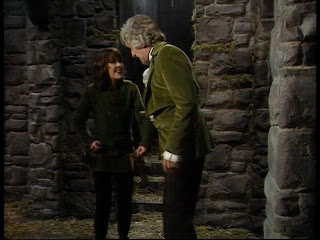
But she can also be vulnerable and scared when necessary. Elizabeth Sladen is wonderful throughout. She was cast for her ability to show both fear and courage at the same time, something she does superbly, but Sladen pours herself into every moment of the role. Her first scene, meeting the Doctor, is terrific. He almost immediately sees through her cover story for sneaking into a top secret science complex, but she just as quickly figures out that he probably won't give her away; her knowing smile when she asks him why he won't give her up is a perfect touch. Later in the story, I love the scene where she meets Irongron, and is so fiery that he decides not to throw her in the dungeon and just leaves her standing around for awhile so her antics can amuse him. She's funny, wistful, and just totally charming. And she has great chemistry with Pertwee; it's just a blast to watch them together. She's completely engaging and full of personality, and single-handedly elevates the tale.
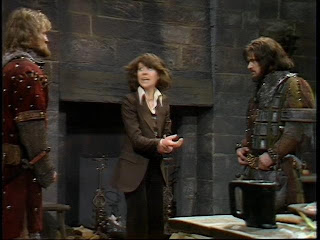
Not that it isn't good anyway. It's a Robert Holmes script, and as expected, it's more dialogue-driven than anything else, but what awesome dialogue!
The Doctor: A straight line may be the shortest distance between two points, but it is by no means the most interesting,
Sarah Jane: You're serious, aren't you?
The Doctor: About what I do, yes. Not necessarily about the way I do it.
Linx: What is this?
Irongron: Oh, just a girl, taken in the forest.
Linx: Girl? You have two species on this planet?!
Irongron: How say you?
Linx: The girl is not of your kind, Irongron. The hair is finer, the thorax of a different construction...
Irongron: Oh, Hell's teeth, have you no girls beyond the stars? No women to do the lowly work?
Linx: Ah, I understand. You have a primary and secondary reproductive cycle. It is an inefficient system. You should change it.

Sarah Jane: Oh, I could murder a cup of tea.
He does a nice job with the medieval dialogue - it's wordy enough to sound convincingly old-fashioned but not so much it's ever confusing or distracting. More importantly, it has as much wit and style as the more modern dialogue. And as you'd expect from Holmes, The Time Warrior has a gallery of great characters.

The villains are a blast together. The arrogant Irongron thinks he's far, far smarter than he really is, and keeps trying to undermine the technologically and intellectually superior Linx, and gets by with a couple minor victories in their verbal sparring through sheer persistence. David Daker is hilarious as the bandit, but manages to be intimidating and threatening as well when need be.

Linx is the more memorable of the two, though, as the first Sontaran to show up in Doctor Who. Despite a few rough edges, the makeup design is excellent, and makes him one of the most convincing aliens on the show. And the race itself is interesting: a clone race of warriors, inherently tough physically anyway, but with the addition of their armor, incredibly difficult to kill except for a small vent on the back of the neck. They prefer it that way, so that they're always forced to face forward in battle, and can never retreat. Very cool.

The third villain, Bloodaxe, is Irongron's right hand man, and thinks he's pretty much the coolest guy in the entire world, and remains completely oblivious to what an idiot his boss really is. John J. Carney is highly amusing in the role.
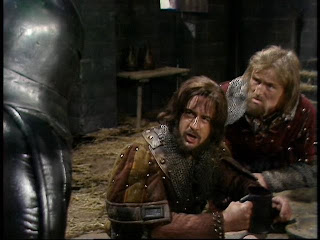
Irongron: I'll chop him up so fine not even a sparrow will fill its beak!
Bloodaxe: [in awe] Yours is indeed a towering intelligence!
There are two other major supporting characters. The first, Rubeish, is a charming, witty variation on the absent-minded professor. He's so near-sighted that, because he doesn't have his glasses, Linx can't hypnotize him, allowing him to help the Doctor to what little extend his near-blindness allows. Mostly, though, he just adds to the overall sense of fun.

Rubeish: I haven't seen my wife and family for three days.
Doctor: Well, I'm sorry to hear that.
Rubeish: Ah well. Just shows there's always a silver lining.
The other is Hal the archer, played forcefully and charismatically by Jeremy Bulloch. He's likable and engaging enough that he might have even made a pretty good companion, though with Sarah Jane around, he wasn't really needed.

The less important characters are also good - the Lord and Lady of the nearby castle, despite only having a few scenes, have a well-developed relationship and personalities. You get a real sense of who they are in just a handful of lines. Even minor one-sceen characters are interesting individuals - they all have interesting things to say and do and add to the setting.

And, of course, there's the Doctor, who's as brilliant as ever. Pertwee is at the top of his game, swinging from chandeliers, passionately decrying evil, wittily cutting down his opponents, and just generally being the dashing, heroic figure he so perfectly created in his version of the character.

 Director Alan Bromly generally does a good job giving a dialogue-dirven script plenty of energy and capturing the midieval atmosphere well enough. Unfortunately, though, while it's a perfectly adequate approach, he doesn't bring any passion to his storytelling. In particular, he doesn't seem terribly interested in the action scenes - they're competantly staged but indifferently shot and edited, and as a consequence, exciting enough but nowhere near as thrilling as they should be. Barry Letts tells a story that for the climax, which called for a castle to be blown up, he told Bromly that they could, in fact, blow up a model castle (and it's worth noting here that blowing up models is the one special effect that Doctor Who consistently does well) ... and Bromly turned it down, saying he would cut it together in a way that would work. He spliced in two seconds of a quarry blowing up.
Bromly should have been ashamed of himself. NOTE TO ALL DIRECTORS OF ANY AND EVERY FILM OR TELEVISION MEDIUM: If your producer tells you that you have the resources, money, and time to film the massive explosion your climax calls for, don't turn him down. That may just be the worst decision every made by any director in the history of television, possibly excepting the entirety of the Star Wars Christmas Special. Seriously, what was Bromly thinking?

Point being, the climax, while not unexciting, isn't the thrill ride it should be, despite big stunts, various acts of derring-do, treachery, archery, and a castle blowing up (or what was supposed to be a castle blowing up). But, to be fair, Holmes doesn't come up with a perfect conclusion. (though the castle blowing up was an excellent idea, Bromly) It's satisfying enough, but the Linx/Irongron double-act doesn't fully pay off, and there's nothing particularly memorable about the way he wraps up outside of those few elements Bromly botches. Really, though, it's more Bromly than Holmes; with a Douglas Camfield or David Maloney or Graeme Harper directing, I'm sure it would have been terrific. Heck, if Letts himself had directed it like he originally planned, it would have been great.

Ultimately, The Time Warrior has all the elements of a classic, but falls short due to Bromly's lack of adventurousness and Holmes not quite figuring out how to wrap things up. But it's a total delight nonetheless, consistently entertaining and a lot of fun, and is a must-see for the introduction of the greatest companion the Doctor ever had in Sarah Jane Smith.
RATING:
* * *
SIDENOTES:

The Time Warrior stands at an interesting point in Doctor Who's history, and is an important story. First off, it has an awesome new title sequence, created with the slitscan technique from 2001: A Space Odyssey and introducing the logo that would become synonymous with Tom Baker's era.


It's the opening of the 11th season, which producer Barry Letts and script editor Terrance Dicks decided would be their last. It's clear even here that their era is coming to an end. With Roger Delgado tragically killed in a car accident, the Master was no longer the kind of recurring character he had been, and wouldn't be seen again for several seasons. Jo Grant, who had been the Doctor's companion for three years, had exited at the end of The Green Death the previous season. UNIT no longer carries the importance of the previous four seasons. The Brigadier gets a few good exchanges with the Doctor at the beginning, but disappears before the end of the first episode.
The Time Warrior is also one of the earliest "pseudo-historicals", the tales set in Earth's past but with a sci-fi plot. It had been done a few times before - The Time Meddler is probably the best example - but in general, it was still a fairly rare concept. Nowadays, it takes up about a third of every season... It also introduces the Sontarans, a race who define themselves entire through war.

But none of that is what makes this episode really important. No, what truly makes this one of the turning points of the show is the companion: Sarah Jane Smith.

Sarah Jane is the perfect template for a companion. She's strong, brave, resourceful, and independent. She gets captured in this story, but she always breaks herself out; she doesn't need the Doctor to rescue her. In fact, she rescues the Doctor on more than one occasion. She shows supreme self-confidence, and is more than willing to cut the Doctor down to size. Here, in her first adventure, she spends much of the story believing the Doctor to be the villain, and takes a long time (understandably) to fully trust him. It's a blast to watch her carry so much of the story through her own strength. And she abjectly refuses to make coffee for the Doctor.
But she can also be vulnerable and scared when necessary. Elizabeth Sladen is wonderful throughout. She was cast for her ability to show both fear and courage at the same time, something she does superbly, but Sladen pours herself into every moment of the role. Her first scene, meeting the Doctor, is terrific. He almost immediately sees through her cover story for sneaking into a top secret science complex, but she just as quickly figures out that he probably won't give her away; her knowing smile when she asks him why he won't give her up is a perfect touch. Later in the story, I love the scene where she meets Irongron, and is so fiery that he decides not to throw her in the dungeon and just leaves her standing around for awhile so her antics can amuse him. She's funny, wistful, and just totally charming. And she has great chemistry with Pertwee; it's just a blast to watch them together. She's completely engaging and full of personality, and single-handedly elevates the tale.

Not that it isn't good anyway. It's a Robert Holmes script, and as expected, it's more dialogue-driven than anything else, but what awesome dialogue!
The Doctor: A straight line may be the shortest distance between two points, but it is by no means the most interesting,
Sarah Jane: You're serious, aren't you?
The Doctor: About what I do, yes. Not necessarily about the way I do it.
Linx: What is this?
Irongron: Oh, just a girl, taken in the forest.
Linx: Girl? You have two species on this planet?!
Irongron: How say you?
Linx: The girl is not of your kind, Irongron. The hair is finer, the thorax of a different construction...
Irongron: Oh, Hell's teeth, have you no girls beyond the stars? No women to do the lowly work?
Linx: Ah, I understand. You have a primary and secondary reproductive cycle. It is an inefficient system. You should change it.

Sarah Jane: Oh, I could murder a cup of tea.
He does a nice job with the medieval dialogue - it's wordy enough to sound convincingly old-fashioned but not so much it's ever confusing or distracting. More importantly, it has as much wit and style as the more modern dialogue. And as you'd expect from Holmes, The Time Warrior has a gallery of great characters.

The villains are a blast together. The arrogant Irongron thinks he's far, far smarter than he really is, and keeps trying to undermine the technologically and intellectually superior Linx, and gets by with a couple minor victories in their verbal sparring through sheer persistence. David Daker is hilarious as the bandit, but manages to be intimidating and threatening as well when need be.

Linx is the more memorable of the two, though, as the first Sontaran to show up in Doctor Who. Despite a few rough edges, the makeup design is excellent, and makes him one of the most convincing aliens on the show. And the race itself is interesting: a clone race of warriors, inherently tough physically anyway, but with the addition of their armor, incredibly difficult to kill except for a small vent on the back of the neck. They prefer it that way, so that they're always forced to face forward in battle, and can never retreat. Very cool.

The third villain, Bloodaxe, is Irongron's right hand man, and thinks he's pretty much the coolest guy in the entire world, and remains completely oblivious to what an idiot his boss really is. John J. Carney is highly amusing in the role.

Irongron: I'll chop him up so fine not even a sparrow will fill its beak!
Bloodaxe: [in awe] Yours is indeed a towering intelligence!
There are two other major supporting characters. The first, Rubeish, is a charming, witty variation on the absent-minded professor. He's so near-sighted that, because he doesn't have his glasses, Linx can't hypnotize him, allowing him to help the Doctor to what little extend his near-blindness allows. Mostly, though, he just adds to the overall sense of fun.

Rubeish: I haven't seen my wife and family for three days.
Doctor: Well, I'm sorry to hear that.
Rubeish: Ah well. Just shows there's always a silver lining.
The other is Hal the archer, played forcefully and charismatically by Jeremy Bulloch. He's likable and engaging enough that he might have even made a pretty good companion, though with Sarah Jane around, he wasn't really needed.

The less important characters are also good - the Lord and Lady of the nearby castle, despite only having a few scenes, have a well-developed relationship and personalities. You get a real sense of who they are in just a handful of lines. Even minor one-sceen characters are interesting individuals - they all have interesting things to say and do and add to the setting.

And, of course, there's the Doctor, who's as brilliant as ever. Pertwee is at the top of his game, swinging from chandeliers, passionately decrying evil, wittily cutting down his opponents, and just generally being the dashing, heroic figure he so perfectly created in his version of the character.


Bromly should have been ashamed of himself. NOTE TO ALL DIRECTORS OF ANY AND EVERY FILM OR TELEVISION MEDIUM: If your producer tells you that you have the resources, money, and time to film the massive explosion your climax calls for, don't turn him down. That may just be the worst decision every made by any director in the history of television, possibly excepting the entirety of the Star Wars Christmas Special. Seriously, what was Bromly thinking?

Point being, the climax, while not unexciting, isn't the thrill ride it should be, despite big stunts, various acts of derring-do, treachery, archery, and a castle blowing up (or what was supposed to be a castle blowing up). But, to be fair, Holmes doesn't come up with a perfect conclusion. (though the castle blowing up was an excellent idea, Bromly) It's satisfying enough, but the Linx/Irongron double-act doesn't fully pay off, and there's nothing particularly memorable about the way he wraps up outside of those few elements Bromly botches. Really, though, it's more Bromly than Holmes; with a Douglas Camfield or David Maloney or Graeme Harper directing, I'm sure it would have been terrific. Heck, if Letts himself had directed it like he originally planned, it would have been great.

Ultimately, The Time Warrior has all the elements of a classic, but falls short due to Bromly's lack of adventurousness and Holmes not quite figuring out how to wrap things up. But it's a total delight nonetheless, consistently entertaining and a lot of fun, and is a must-see for the introduction of the greatest companion the Doctor ever had in Sarah Jane Smith.

RATING:
* * *
SIDENOTES:
- Jeremy Bulloch is probably best known for playing Boba Fett in the original Star Wars films, but he also played another character in Doctor Who about ten years earlier in The Space Museum, although that role mostly just asked him to stand around with his arms akimbo. He's much, much better here with an actual role.
- The DVD is one of the occasional releases where the Restoration Team added CGI effects to try to make up for the low-budget old ones. While I certainly appreciate their efforts, I've always found these to be a bit hit-or-miss. When they work, they lift the story to an even higher level - Dalek Invasion of Earth and Earthshock come to mind. But too often, they're jarring because the CGI often looks like CGI. This, unfortunately, is one of those cases. Yes, it's nice to see the castle blow up, but they're too obviously CGI flames. Yes, it's nice to see the spacecraft flying toward the earth, but it looks just as cheap as the original shots, even if they are a tad more dynamic. But hey, you can't get it right all the time, and I'm really glad for the times when their additions work. (and I'm really looking forward to their version of Day of the Daleks) And I'm especially glad that they consistently make the original version the default way of watching, and their altered versions in the special features.
Monday, February 21, 2011
Terror of the Autons
[1971 – Season 8, Serial 1]
We begin in a circus. Luigi Rossini, the owner, is stopped in his tracks by an astonishing event. A sound familiar to us occurs: the whine of a TARDIS – but not the Doctor’s. A van appears directly in front of Rossini. Out of the trailer steps a man dressed in black. He introduces himself, saying he is usually referred to as The Master. Rossini, assuming this guy is a conjurer looking for a job, tries to throw him out. The Master turns towards him an hypnotizes him with a single look. Rossini is his to command.


In his first story, he is working with the Nestine Consciousness, head of the Autons, those horrific plastic creatures from Spearhead In Space. He aids their attempt to conquer the earth for reasons known only to him.
Terror of the Autons is, in many ways, a milestone Doctor Who story. It completes the UNIT family by introducing Captain Mike Yates. It introduces Jo Grant, who would be the Third Doctor’s companion for three years. And above all, it introduces the Doctor’s archenemy. The Master comes off very well; writer Robert Holmes makes the mix of friendship and mortal rivalry between him and the Doctor compelling and fun.

Ms. Grant’s debut is a bit more controversial. Jo is often regarded as a big step back for feminism, with her meek personality, clumsiness, and apparent uselessness. I think people who see only that side of her are totally missing the point (or only watching her lousy episodes). She’s very much like a good version of Harley Quinn: a relentlessly cheerful, bubbly girl on the surface, and as a consequence constantly underestimated by everyone. But when pushed to it, she shows incredible resourcefulness and bravery, and outwits her apparent betters. I think it’s a joy to watch her, and it’s only helped by the perfect casting.

Katy Manning is so perfectly cast as Jo that it’s easy to forgive her occa… for… I… I… I can’t do it. I can’t say anything even kindly or slightly negative. She’s just so cute, so nice, so sweet. It’d be like kicking a puppy. She’s perfectly wonderful. What’s more, her chemistry with Pertwee is evident right from the beginning; it’s a joy to see these two together.

The other introduction, that of Captain Mike Yates, isn’t so effective. Eventually, the writers would get around to giving him some interesting stuff to do, but here, he evidences no semblance of personality or character. But he’s kept in the background, so it’s no real loss. Otherwise, UNIT is used pretty well. It’s of course wonderful to see the Brig, and UNIT gets in on the action in some good action scenes late in the story.
The Autons have to share the villain light with the Master, which unfortunately means one of them is going to get the short end of the stick, and it’s the otherworldly plastic abominations. They barely appear in the story, and their appearance is lessened by the bigheaded masks they wear, making them far less terrifying.
 |
| Surely, the face of evil itself. |
Still, they have three terrific moments in the story. The fight in the quarry is scary and thrilling, and stands as one of the great moments of the early ‘70s. Their attack on Jo with the flower is incredibly unsettling. And their murder of an unfortunately victim with a hideous plastic doll is both creepy and darkly funny, which makes for quite an uneasy scene.
Given this is a Robert Holmes script, characterization and dialogue is great. Besides the Master and Jo, he does a perfectly fine job with the Doctor and the Brig, and adds two more characters vividly sketched in a limited time: Rex Farrel and his father, Farrel Sr. With just one scene between them, you learn everything about their relationship and the younger Farrel. The father comes across as an overbearing patriarch, disappointed in his son, and obviously unsympathetic, though his strong-willed resistance to the Master gives him points. But when he goes home to his wife, their dialogue totally fleshes him out into a sympathetic, three-dimensional character. He only gets those three scenes, none of them very long, but he’s completely humanized in those brief moments.
The younger Farrel gets a bit more screentime, and does eventually become more than the Master’s hapless victim himself. The portrayal by Michael Wisher is very strong, though fans know he has a much more unforgettable appearance in a later serial…
And the Doctor? Jon Pertwee’s Third Doctor was a man of action, who jumped right into the fray with the full force of his charm, wit, and intelligence. He’s patronizing, egotistic, funny, and totally heroic. He’s one of the most three-dimensional of the Doctors; his flaws aren’t limited to the obvious flaws of the Doctor, nor are his good points limited to his power and heroism. Holmes, not surprisingly, gives him plenty to work with.
Rossini: I don't think my friend's going to like you.
Doctor: I'm sure of it.
Doctor: How much are they paying you?
Rossini: Come, come, Doctor, gentlemen don't discuss money.
Doctor: Nonsense. Gentlemen never talk about anything else.
Jo: Doctor, stop being childish.
Doctor: What's wrong with being childish? I like being childish.
I love the way the Doctor turns on the "pen-pusher" in Episode 3, and then pretty much turns him to his side in a few smooth lines of dialogue. I also love the very knowing look Jo gives the Doctor when he calls the Master self-conceited.


For all its good point, Terror of the Autons doesn’t really amount to much. It’s another invasion of Earth, foiled at the last minute. Other than the Master’s last bit, the finale has little tension or meaning. It’s done very well, of course, but it’s a pretty weak story to hang such wonderful execution on. Still, great execution of a so-so story in almost every aspect is more than worth a look. It may not be special or particularly compelling, but it’s very entertaining.
* * *
Thursday, February 17, 2011
The Ribos Operation
[1978 – Season 16, Serial 1]
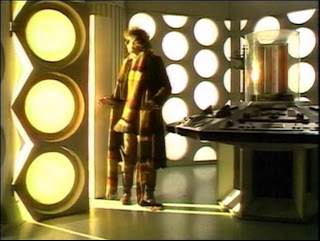

The early Doctor Who stories were in the form of Serials – feature-lenth stories spread over several episodes. By the ‘70s, four 25-minute parts were generally found to be optimal: enough time for substantial character development and plotting, not (usually) enough time to get boring. Now, in his second season as producer, Graham Williams was eager to make a mark on the series besides “not as good as the last two guys,” and tried for a novel, ambitious idea: interlinking an entire season of serials into one massive, epic story. Of course, today, there’s nothing special about the notion, but it was pretty impressively original at the time.
The story: The Doctor is confronted by the White Guardian – a stunningly powerful being whose power dwarfs even that of the Time Lords. The Guardian sends him on a mission: gather the six pieces of the Key To Time, which will enable him to keep the universe from falling into chaos. The pieces have disguised themselves into all manor of objects, but will be given a way to find the objects and return them to their original state. He would be aided in this quest by a fellow Time Lord, Romana, and would be opposed by the unknown forces of the Black Guardian. It was an epic idea, and for a while, it played out very well. In the end, it never came to a satisfying conclusion, and the format wouldn’t be tried again for nearly a decade, but it certainly started with a bang.
For the first episode, The Ribos Operation, Williams turned to former script editor Robert Holmes. Holmes is rightly regarded as the best writer of Doctor Who’s classic era, having written or co-written among others Spearhead in Space, Carnival of Monsters, Pyramids of Mars, The Brain of Morbius, The Talons of Weng-Chiang, and The Caves of Androzani, and this lives up to his reputation.
The opening appearance of the White Guardian, however, was written by Williams and script editor Anthony Read, and it is itself an excellent opening. The TARDIS is taken off-course and its doors forced open with incredible ease, after which the Doctor walks out to the world he’s been brought to…

Which isn’t exactly expected. In fact, the quiet underplaying of the White Guardian visually and performance-wise contrasted with mind-boggling things he says rather casually:
Doctor: Ah! You want me to volunteer, is that it?
White Guardian: Precisely.
Doctor: And if I don’t?
White Guardian: Nothing.
Doctor: Nothing? You mean nothing will happen to me?
White Guardian: Nothing at all. Ever.
After that, we meet Romanadvoratrelunder, a name the Doctor shortens over protest to Romana.
Romana turns out to be one of the Doctor’s greatest companions, not least because, as a fellow Time Lord, she every bit as intelligent (or at least very nearly) as the Doctor himself. It’s a blast to watch her wittily deflate the Doctor like no one else could. Mary Tamm plays her with both great humor and regality, and her dialogue with the Doctor is one of the highlights of this story.

Romana: What would you like me to do?
Doctor: I’d like you to stay out of my way as much as possible. I don’t suppose you can make tea?
Romana: Tea?
Doctor: No, no, I don’t suppose you can. They don’t teach you anything useful at the academy, do they?
Romana: It’s funny, before I met you, I was even willing to be impressed.
Doctor: Indeed?
Romana: Oh, yes. Of course, now, I realize that your behavior comes from a sub transitory experiential hypertoid induced condition aggravated I expect by multi- and cathelogical tensions.
Doctor: … what’s that supposed to mean?
Romana: Well, to put it very simply, Doctor, you’re suffering from a massive confrontation syndrome.
Doctor: Is that the sort of rubbish they’re pouring into you at the academy?
Romana: You know, I might even use your case in my thesis when I get back.
Doctor: I’ll call you “Romana.”
Romana: I don’t like Romana.
Doctor: It’s either Romana or Fred.
Romana: All right, call me Fred.
Doctor: Good. Come on, Romana.

But in a Robert Holmes script, dialogue is a highlight throughout, no matter who’s talking. It’s a joy simply to listen to the people talking, regardless of plot. It’s also got Holmes’s trademark double acts – the Doctor & Romana, of course, but also Garron and Ustoffe, a truly hilarious pair of conmen, and Graff Vynda K and Sholakh as the villain and his second-in-command. Graff Vynda-K is a particularly noteworthy character. Even though he’s enjoyably evil, he’s superbly fleshed out and totally three-dimensional.
 |
| Graff Vynda-K and Sholakh |
The Ribos Operation takes place on a world stuck in its own dark ages. Intergalactic conmen Garron and Ustoffe are attempting to sell it to Graff Vynda-K, an exiled tyrant of another planet. The planet should be worthless to the Graff, but Garron and Ustoffe are trying to convince him that it’s actually rich in Jethrik, the most valuable mineral in the galaxy, even though the only Jethrik on the planet is a large slab Garron and Ustoffe themselves brought there. Into this mix enter the Doctor and Romana, who realize the first piece of the Key is, in fact, the piece of Jethrik the two cons are carrying about.
 |
| Garron and Ustoffe |
This being a story of cons, things get bad quickly, and a vengeful Graff Vinda-K attempts to execute them all, assuming the Doctor and Romana are with the cons.
Graff Vinda-K: [to Garron] Get up, you cringing cur!
Doctor: Uh, yes, get up, you cringing cur!
Garron: Oh, just, ah, taking my friends for a little stroll.
Graff Vinda-K: Don’t lie to me! [moves to hit Garron]
Doctor: Don’t hurt the cringing cur!
It’s an engaging yarn, filled to the brim with double-crosses and witty exchanges, but the best part of the story is only barely connected to the plot, and that’s the character of Binro. Binro is an outcast on the world of Ribos for believing that Ribos orbits a star. His story adds a remarkable emotional power to the story, and through him Holmes fleshes out the world of Ribos more than all manor of technical wizardry ever could.
It’s a terrific, crackling script throughout. Holmes even knows how to use K-9 effectively. I like K-9, but he’s an exceedingly difficult character to use effectively. Holmes nails it, keeping him convincingly out of the action for the first two-thirds, and using him nicely in the last.

The only real flaws come from the production and one of the actors. Director George Spenton-Foster does a terrific job staging a dialogue-heavy story, giving it plenty of energy. The entire story is shot on rather small interior sets, but they’re excellent sets, if a bit tight. The costumes are spectacular. The only real issues are the monster who rear their rubbery head briefly. Both are pretty cheap, unimpressive monster. Fortunately, each of them only have a small part to play in the story, and Spenton-Foster minimizes their screen time.

Most of the performances are sterling. Unfortunately, the one occasional weak link is the Doctor himself, Tom Baker. Oh, he’s a great Doctor, when he’s good in Ribos Operation, he’s spectacular. But this was his fifth season as the Doctor, and in some of his later performances, he tended to overplay the comedy he loved so much, letting it bleed into scenes that required seriousness. This isn’t nearly as bad as it would get in the next season on a few occasions, but Tom’s shenanigans turn a couple of major dramatic scenes into a cartoonish slapstick routine. He’s ever so much funnier when he reads his funny lines seriously. Fortunately, only a few scenes suffer from his unfortunate tendancies; most of Ribos is blessed with Tom at his most magnificent.

RATING:
* * * ½
SIDENOTES:
· Cyril Luckham’s performance as the White Guardian really is wonderful. He underplays it beautifully, as though the Guardian isn’t really concerned with the universe plunging into chaos. It’s just another day on the job. It makes it much more convincing and mind-blowing than a more obviously “mystical” reading or more over-the-top portrayals (as future appearances of the Guardians proved). His reading of “Beware,” as though it’s slightly amusing to him, is a great exit.


· The difference between “Bad Tom” and “Good Tom” are actually pretty subtle in pictures, but unmistakable when watching. Nonetheless, I tried to capture it. First, Bad Tom, from the cliffhanger in episode 2, where his face actually ruins the Graff ordering his execution.

And now, Good Tom, from the scene where Garron tells him the background of Graff:

It’s really hard to show in a still, but Baker’s intensity add tremendously to the sequence. His face raises the scene from good exposition and background to gripping and powerful. That’s one of the reasons Season 12 felt so promising, even when it dropped to junk like Revenge of the Cybermen: it was an entire season of Good Tom, and Good Tom is magnificent.

And now, Good Tom, from the scene where Garron tells him the background of Graff:

It’s really hard to show in a still, but Baker’s intensity add tremendously to the sequence. His face raises the scene from good exposition and background to gripping and powerful. That’s one of the reasons Season 12 felt so promising, even when it dropped to junk like Revenge of the Cybermen: it was an entire season of Good Tom, and Good Tom is magnificent.
Wednesday, February 16, 2011
The Brain of Morbius

[1976 – Season 14, Serial 5]
One issue with science fiction, fantasy, and horror is that while it opens up every door possible to the imagination, there is a very fine line between compellingly imaginative and hilariously silly. The Brain of Morbius takes that line, laughs at it, and dances all over and around it with unrestrained glee. It’s dark, and tragic, and powerful, and intense, and goofy, and ridiculous, and wildly over-the-top, and horrific, all at the same time. And somehow, it not only works, but transcends itself into something brilliant and special.
The Doctor and Sarah Jane arrive on Karn, a planet not far from the Doctor’s home planet of Gallifry. They soon encounter not only the Sisterhood, a mystical band of women guarding the secret of immortality, but also an ingenius but warped scientist named Dr. Victor Frankenstein Dr. Solon and his hunchbacked, hook-handed assistant Fritz Condo. Solon has in his possession the brain of the evil Time Lord Morbius, and is rebuilding a body for him. And he thinks the Doctor has the perfect head…

The original script was written by Terrance Dicks, then overhauled by script editor Robert Holmes, and the result is a script from two of the greatest writers in the history of Doctor Who. The characters are terrific. Dr. Solon and Morbius are both an incredibly rare breed of villain: wildly overblown caricatures with “take over the universe” sorts of ambitions who are also complex, well-shaded characters. There’s just enough element of tragedy to make them interesting, but not so much that we regret their fates. Condo is, of course, a dumb brute, but he’s a dumb brute with emotional depth. The Sisterhood is a fascinating group whose obsession with immortality has frozen their culture in time. Without death and birth, they can never move forward.
But the highlights are the two regulars. Tom Baker’s Doctor is at his peak. He is, of course, hysterically funny. I love the scene when they first march up to Solon’s castle in the rain. When Solon opens the door, they’re absolutely drenched as it practically monsoons outside. The Doctor’s greeting: “Can you spare a glass of water?” But he’s also very serious when called on, and with his deep voice and large frame, Baker has an unbeatable presence when solemn. His concern for Sarah Jane, his solving of the dying flame with science, and his climactic showdown with Morbius knowing he’ll probably die in the process are all fantastic moments.
Sarah has plenty to do herself. I love her cleverness when Solon gives them drinks. But even more than that I love her bravery throughout; even though she’s blinded through most of the story, she shows incredible courage, even wandering outside on an unfamiliar planet to try to warn the Doctor of what’s coming.

And their relationship is beautifully portrayed. Even though Sarah is just a human to the Doctor’s Time Lord, he treats her as a genuine equal. Further, they’re just fun to watch. There’s a great dialogue between them early on as the Doctor yells at the skies, convinced that the Time Lords are manipulated events and trying to get him to do their dirty work for them (though I love that it’s never stated for certain whether or not they did, implied as it may be), while Sarah teases him for being so childish about it.
Meanwhile, this is all set in a wonderful atmosphere. The sets are stunning; Solon’s laboratory is a masterpiece. Director Christopher Barry shoots it brilliantly throughout; it’s a tremendously well-lit, well-shot story. He also plays the suspense for all it’s worth and layers in plenty of eerie horror and violence.
So it’s a compelling, dramatically sound character-driven adventure with great touches of horror, but there are also strong elements of satire, black comedy, and just outright silliness. Probably one of the best examples of this oddness comes when Solon and Condo fight, during which Morbius’s brain is knocked to the ground. Solon tries desperately to save it by putting it in a plastic case with long eyestalks. However, the brain is damaged, and for a while, it runs around in a highly primitive fashion, wanted nothing but to kill. The incredibly intelligent Time Lord reduced to his savage nature.
It’s also a brain sliding around on the floor, then put in a plastic head on top of a body that looks like this:

The first time I watched this episode, I was thrown by the last third, starting with the brain going on the ground, because while it worked, it couldn’t be taken totally seriously. But rewatching I realized that it could be taken very seriously. It's played straight enough and with enough depth to work as horror adventure. It just has to be taken humourously as well.
This is a brilliant episode, and one I love more each time I watch it. It’s great fun, layered with intelligent, wit, and wonderful characters. And it’s all that in ways uniquely Doctor Who.
RATING:
* * * *
SIDENOTES
- [Added: 6/27/11] I just finally watched Bride of Frankenstein. That description of it as simultaneously funny, dramatic, and scary? Very much like Bride, albeit leaning a bit more on the drama and horror scales than its '30s forebear.
Subscribe to:
Posts (Atom)