Wednesday, June 5, 2013

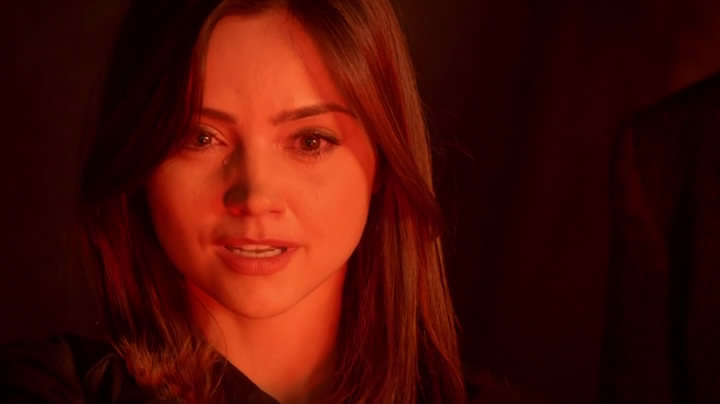
The Crimson Horror


STRAX: And how will [Jenny] locate the Doctor?
MADAME VASTRA: To find him, she needs only ignore all "keep out" signs, go through every locked door, and run towards any form of danger that presents itself.

There's a flip side to my criticisms of Mark Gatiss back in Cold War: he's actually a good writer. His plots might not be interesting in themselves, but they set everything up carefully and build to a climax that follows the story's internal logic. That might sound like basic stuff, but it's the kind of basic stuff Moffat's era struggles with in the midst of all its glorious but underdeveloped ideas. Basically, you can count on Gatiss to get everything put together right technically, and when his story is worth telling, it's good entertainment. Here, Gatiss takes a fresh approach to apparently straightforward material. By focusing on Vastra, Jenny, and Strax, and keeping the Doctor out of the story for the first third, his talents in blending humor, drama, and horror in a competant and entertaining brew rise to the surface.


And to give him some credit, Gatiss has been held back from unleashing the full force of horror he imagines at times - The Unquiet Dead, in particular, was supposed to have included a world of zombies and had a bleaker tone. Gatiss delights in the macabre and leavens it with black humor. Moffat seems to have given him free reign on nightmare fuel, so he builds a story around drowning the Doctor in boiling, blood-colored oatmeal. Later, the now red-skinned Doctor becomes the monster pet to a blind, scarred young woman, whose look suggests monstrosity, and who was raised by a metaphorical monster of an evil woman.

The script overflows with that sort of cleverness. There's a particularly clever suspense sequence as Jenny has to bring the red-skinned, mechanically-walking Doctor down a hall, when the blind daughter of the villainess comes out, hearing them. The scene builds the suspense and complexity in a way that would make Hitchcock proud.


Gatiss also revels in the Victorian era, and the episode drips with atmosphere. Some of that, of course, is thanks to director Saul Metzstein, but Gatiss' story lends itself to a much more vivid exploration than Metzstein's (and Moffat's) The Snowmen. And Gatiss is a huge Sherlock Holmes fan, and builds the story on a winding, complex mystery yarn. (Murray Gold throws in a fun musical reference to Hans Zimmer's Sherlock Holmes scores, although it really isn't quite as cool on a piano that actually works.)

Centering a story around Vastra, Jenny, and Strax works nicely, too. I'm not sure they need a whole series of their own, but they're a pretty engaging trio to come back to every now and again. Jenny is especially showcased, rescuing the Doctor and beating down a half-dozen bad guys in a hallway while barely raising her heartbeat. Strax is a one-joke character, but it's a very funny joke, so as long as he's kept more or less in the background, he's a gas. Vastra, though, feels utilized; she's still a great character, but, as in The Snowmen, it feels like she doesn't really have anything to do.


After reveling in the tension of "When will the Doctor show up?" for a third of the story, and then ratching the tension further with the reveal that the Doctor has been monsterized, Gatiss flies into a flashback about how the Doctor got there. It's a nice way of jamming an extra half hour of story into about 2 minutes onscreen that don't feel overly rushed. And in a nice touch, Metzstein uses sepia tone and similar tricks to make it look like a silent movie.

At which point we finally arrive at the plot itself, with the great Diana Rigg commiting all manner of evil. The character's pretty one-dimensional, but Rigg is magnificent and finds exactly the right mix of humor and sinister insanity to make Mrs. Gilliflower fun. And her aged voice has taken on airs of the older Katherine Hepburn, which only adds to the effect.


DOCTOR: Mrs. Gilliflower, you have no idea what you are dealing with. In the wrong hands, that venom could wipe out all life on this planet.
MRS. GILLIFLOWER: Do you know what these are? [giggles] The wrong hands!

The other major guest character, Ada, is just a brilliantly played by Rigg's real-life daughter, Rachael Stirling. Stirling nails the tragedy, the creepiness, and the hidden strength of Ada; she's a complex character who refuses to actually fall in either the villain or hero camp, even though she always seems to be in one or the other.


As everything rockets toward the finale, Gatiss wisely climaxes primarily with a dialogue scene of five great actors talking very dramatically at each other in a small room. That's the essence of what makes Who great: fantastic, imaginative stories centered on great actors being dramatic. It's a blast of a sequence.

The last little bit of the climax, in the steampunk rocket chamber, isn't quite as strong. Besides the question of how they survived being inside a chamber with a rocket lifting off, it's not as satisfying as the earlier scene, leaving the Doctor as basically a bystander while the guest stars finish off the plot. But then, in this story, that at least makes sense.


Clara is left as a stray appendage, though. There's supposedly an arc about the Doctor discovering who she is, and Clara discovering that there's a lot more to her than there should be, but said "arc" has basically amounted to a half-season of the Doctor asking, "Who is she?" and whoever he asks going, "Dunno." It's less an arc than a dangling thread that refuses to be tied up until the finale. Journey even had her learn about it, then immediately forget. It's as though rather than actually deal with it throughout the season, Moffat's just saving up for the finale, which would be a lot easier to roll with if she had any identity beyond this mystery. It's particularly frustrating here, where she's less of an actual presence than something the Doctor talks in circles about with Vastra and Jenny. Her mysteriousness is all she is.

But how much of that can actually be laid at Gatiss' feet is questionable. The same goes for the final scene, where Clara's two charges insist on being brough along for an adventure because otherwise they'll tell their parents Clara's a time traveler. That's gotta be the least threatening thing they could have hung over her. I mean, really? Are they expecting their parents to actually buy that?


If there's a flaw I'd actually blame on Gatiss (besides underusing Vastra), though, it's the swipes at religion. Gatiss' anti-religious bits are subtle but have a real nastiness to them. I mean, Stephen King does all kinds of evil religious people, but it doesn't actually seem hateful. Gatiss seems to really been sneering at religion itself. It's an odd, off-putting undertone to an otherwise fun yarn.

But that's the thing: this is a really, really fun story. It's freaky, funny, exciting, and acts convincingly like all the silliness is all manner of dramatic without losing its sense of goofy adventure. For the first time since Unquiet Dead, I feel really happy one of Gatiss' episodes exists.


"The bright day is done, child, and you are for the dark."

RATING:

* * *


Tuesday, June 4, 2013

Journey to the Centre of the TARDIS

Tricky: Woah. Awesome.
Doctor: Well put. Woah and awesome.


Here we go! Diving gleefully inside the TARDIS herself, exploring her caverns, library, and the endless, endless corridors!

And this is the new series under Moffat - not a couple rooms like Edge of Destruction, not whatever locations were cheapest like Invasion of Time, not a production trying desperately to live up to the wild visions of a great writer and great director like Castrovalva. And in the wake of The Doctor's Wife, exploring what makes Sexy tick couldn't be more thrilling. This has got to be spectacular.

Unfortunately, rather than give the assignment to a writer-director team like Gaiman and Clark (who did The Doctor's Wife) or another brilliant pair, Moffat assigned Stephen Thompson (who has done good work on Sherlock, but whose only contribution to Who so far has been the forgettable Curse of the Black Spot) to write and Mat King, who has TV experience but has never done something like this. Which is not to say either of them are bad at their jobs or that their work is awful here, but this seems like such a huge episode should have gone to the most reliable people possible, and the mixed results seem to confirm it.

There are plenty of good things about the episode, but Thompson sets them all up on a pretty weak thread. While powering down to the simplest mode so Clara can pilot the TARDIS easily, the Doctor accidentally lowers the shields that keep it safe from salvage ships. One of the said salvage ships immediately picks it up, screwing up its internal systems in the process and leaving Clara lost somewhere in the depth of the TARDIS interior. All of which is reasonable enough.


But the Doctor then brings onboard the salvagers to help him look, despite lacking any apparently reason to trust them. I mean, the idea that the Doctor can't find Clara with the help of Sexy herself in time, but will be helped by three not-so-bright and obviously untrustworthy salvagers is just strange. It's almost saved by the Doctor locking them inside to help him, but they're so stupid they almost immediately forget about the whole "self-destruct" thing and start stealing stuff. I mean, how do they not realize that's not going to be helpful? And the Doctor actually agrees to splitting up so they can either A) get lost in the maze or B) strip everything down? Does he really not think they're going to start stealing everything?

It might work if the salvagers themselves were credible characters, but they're flat, simplistic characterizations that don't add up. In particular, the idea that they convinced one of the three he was an android as a joke is patently ridiculous and makes no sense. None of these three are compelling or even interesting. Worse, their presence weakens the Doctor as a character in the scene in the tree - rather than Doctorishly getting them to back down, he just begs Gregor to put back the light-egg. When Gregor refuses, the Doctor sheepishly gives up.  What happened to the Doctor who scared off entire alien invasions with a few sentences?


Since most of the plot is built around these three, the story never really works until it jettisons them toward the climax. What little plot and character do exist fall apart in the final moments, where the Doctor just hits a reset button (though the "Big Friendly Button" bit was a nice touch). It's really hard to make a reset button that erases all consequences actually work. It's not awful here - the Doctor remembers, and The Name of the Doctor does an okay job of picking up the threads left here - but it does make the story unsatisfying and inconsequential.

It's especially frustrating because the climactic scenes bring a spectacular tension to the relationship between the Doctor and Clara. She's infuriated at the Doctor keeping secrets about what's happening and, worse about who she is, and rightly so. The Doctor responds that secrets keep people safe, but he's wrong here, and she puts him on the spot for it. Their immanent death brings out fantastic character development (and spectacular acting from Smith and Coleman)... which is then erased minutes later. It's possible to make a massive reset button work - the Angel episode "I Will Remember You" comes to mind, where Angel remembers what happened and makes a genuine sacrifice that haunts him for the rest of the show. But nothing is lost or learned here. The Doctor seems to retain his memories, but it has no significant impact. And it's too bad; their confrontations outside the Eye of Harmony and in the Engine of the TARDIS carry tremendous dramatic power.


Which would be easier to forgive if it was consistently exciting, but until the last 10 minutes, director Mat King has everything simmer very quietly. The music and canted camera angles suggest he's going for an atmosphere of strangeness, but it has never approaches the sense of weirdness of, well, any of the Hartnell sci-fi stories. It all feels too low-key and low-stakes. A higher-energy approach might have at least distracted us from all the script's failings.

I guess writer Steven Thompson was trying to go for something a little different than just "monster chases the Doctor and Clara around the TARDIS", but what he does here hinges on characters and motivations that just never click. Besides, it does end up boiling down to "being chased by creepy monsters", which are the only really involving scenes before the Eye of Harmony.


What does work is the TARDIS interior itself. Thompson and King might flop on character and plot, but they do the world-building brilliantly. There's no end of spectacular imagery, rich in symbolism - the books contained in vials of liquid (knowledge drunk and spilled), the upside-down tree of mechanical wires and eggs (a machine's Tree of Life, its fruit stolen by the intruder), the way time itself starts screwing up resulting in all manner of chaos.

The climactic scenes are particularly stunning - the Eye of Harmony is "An exploding star in the act of becoming a black hole", suspended above a catwalk (because of course it is). The Engine, too, is a knockout. The episode might not get stuff like "plot" or "character" working correctly, but underneath those weak constructs is something wonderful.


In tearing open the TARDIS, the ship that creates the show, the show tears open Moffat's vision itself. The core, the machinery, the engine, are pure genius. Surrounding and driving that genius are a dozen chaotic pieces of fragmented storytelling, compelling when it puts the pieces together right, infuriating when it doesn't. And for all its pieces of genius, too often, it doesn't find how to put those together. 

With a dazzling actor in Matt Smith, who can fly smoothly from funny to furious to deeply emotional to brilliantly manipulative and back again in a flash, they create a Doctor who begs a regular human to please not take the light egg like he's a five-year-old asking his big brother to not steal his Legos. With Coleman, who can't be anything less than delightfully charming but can turn to a riveting rage or horrifying fear on a turn, they create a companion who's entertaining but so wrapped up in her own mysteriousness she lacks any distinguishing characteristics. And with ideas and stories rich in metaphor, symbolism, and emotion, and the production values to live up to the ideas, they create episodes with messy plotting and rushed pacing that doesn't allow those ideas and productions to flourish.

But deep down, it's wonderful. And sometimes, all the pieces fall in place perfectly. And when it does, it's a work of beauty like Television has never seen before and will never see again. Which only makes it all the more frustrating all the times it doesn't get the pieces together.

RATING:

* * ½


SIDENOTES:

  • Clara: "Red flashing light. Means something bad. 'Get out here fast?' Possibly, 'Whatever you do, don't open this door.' [opens door] Bad decision."
  • Coleman's delightful throughout, but the highlight is her delivery of the line, "That will not be a problem." Smith, naturally, is just as much fun, bouncing from his goofiest to his most manipulative to his most scared. The script might not give him much to work with, but he takes what he gets and just goes wild with it.
  • The Doctor claims the TARDIS is infinite, at which point Gregor (I think) responds, "It'll take hours." The Doctor: "Days." I hope that was all intended as a joke - the TARDIS is established as having a definite, if constantly changing and gigantic, size. The Doctor suggesting it'll only take a few days to search infinity is a funny idea, but I don't think it's set up right, and the whole thing isn't set up like it's supposed to be funny.

Saturday, May 18, 2013

Hide


In the midst of a frustrating season delivering mostly entertaining but deeply flawed episodes, Hide stands as a much-needed reminder of the heights Doctor Who can scale. And it does so in a small, personal story where the stakes are rarely higher than a single life, and never higher than a handful.

And it's a 45-minute story that works beautifully. I think 90 minutes is a more natural fit for this show in general, but for all my problems with individual single-parters, I really have nothing inherently against the format when done well. And it's done very well here - a simple, character-driven story full of atmospheric horror and deeply felt emotion.


Its success lies primarily in its characters and the performances. In a savvy move, writer Neil Cross reflects the Doctor and Clara in the other two characters: Professor Palmer (Dougray Scott, a great actor who, sadly, I always remember as the bad guy in Mission Impossible II), a genius, something of a Renaissance Man, but also a haunted war hero researching the supernatural; and his assistant Emma Grayling (Jessica Raine, who will play Verity Lambert in An Adventure In Space and Time), a compassionate but lonely psychic longing for the Professor.


Setting them as reflections allows for compelling conversation. The Doctor and Palmer, who seems almost like a low-key, human version of the Doctor, discuss what so haunts the Professor: "I didn't mind dying for that cause. It was a very, very fine cause..." but he's horrified at having been forced to send others to their deaths.

DOCTOR: "If you could contact them, what would you say?"
PALMER: "I'd very much like to thank them."

Of course, the Doctor has been haunted throughout New Who by the Time War, but more recently, his torment stems from his companions. As he said in Let's Kill Hitler, when reminded of his most recent companions, he mostly feels guilt. Rose was torn away into another dimension; Martha left because in favor of a (relatively) ordinary life, partly because the Doctor mistreated her; Donna's story, of course, ended in tears; and now, Amy and Rory were taken from him by a brutal time paradox that keeps him forever away. Even knowing they all went on to lead happy lives is little consolation.


Later, when the Doctor takes Clara through the whole history of the Earth (a fantastic scene, by the way), she's stunned. "To you, I haven't even been born yet. And to you, I'm already dead." And while he naturally doesn't quite see it that way, being a Time Lord, it does reside in his mind. It's why so often he simply abandons the companions in a time and place where they'll be happy - that way, somewhere out there, they're always alive. There's something selfish in it - an inability to deal with death and goodbyes. And for an immortal traveling infinity, he'll always have to deal with those. And all this starts to hit home for Clara.

CLARA: To you, I'm a ghost. We're all ghosts to you. We must be nothing."
DOCTOR: "No. You're not that."
CLARA: "Then what are we? What can we possibly be?"
DOCTOR: "You are the only mystery worth solving."

There's tremendous history and an epic power in their conversation - in a way, every farewell from The Dalek Invasion of Earth until now haunts the conversation. But there's also something deeply personal to give it even greater resonance: Clara herself. It's a moment of personal vulnerability we haven't really seen from such an outwardly cock-sure, energetic and apparently brave girl.


Clara spends time talking with Emma, which results in one of the most bizarrely on-the-nose failures of the Bechdel Test ever - while the Doctor and Palmer have a quietly searing discussion brimming with subtext about death and losing comrades, the girls mostly just talk about boys. Still, it's a thoughtfully written conversation, so it's worth looking at on its own merits. As with the Doctor / Palmer conversation reflecting the Doctor's relationship with companions, the Emma / Clara conversation nicely parallels - and contrasts - relationships between the Doctor and his companions. Both Emma and Clara have feelings for their partner, but neither admit it. But Emma warns Clara not to trust the Doctor: "There's a sliver of ice in his heart."

Later, after the Doctor and Clara traverse the Earth's history, Emma senses Clara's torment:

EMMA: What's wrong?
CLARA: Just saw something I wish I hadn't.
EMMA: What did you see?
CLARA: That everything ends.
EMMA: No, not everything. Not love. Not always.

If there's something keeping their conversations from reaching the higher plane the other conversation reaches, it's strangely that Clara's less well-defined than Emma. This episode does more than any other to flesh her out, digging beneath her brash exterior, but she's still a strangely generic companion elevated by a fantastic actress. I do love the stuff about the TARDIS not liking her, but I'm still waiting for her to get the level of development the other New Who companions had by the end of their first adventure. Her fear is nicely explored, though. I particularly like the conversation where the Doctor tries to get her to explore the haunted house, and she refuses until finally telling him to dare her. Even if she's not especially well defined, she's fleshed out nicely for an episode that doesn't really focus on her.

On the other hand, the Doctor is on fire here, getting to be properly Doctorish throughout in a way he rarely does this season. His alien nature comes across well - I love the Doctor going on about how lonely she is right in front of her, totally missing how utterly insensitive it is. His later conversation with Emma right before diving across universes also shines:

EMMA: Doctor? Will it hurt?
DOCTOR: No. Well, yes, probably. A bit. Well, quite a lot. I don't know, it might be agony. To be perfectly honest, I'll be interested to find out.


He also gets plenty of moments of cleverness, humor, and derring-do, particularly in the second half, as he throws himself into the collapsing pocket universe.

Which finally brings around to the story itself, which works beautifully - it's scary, intelligent, and perfectly paced. The ghost stuff never runs out of clever bits to do, and the second half delvers all kinds of adventure and frightening moments. If there's a problem, it's that the ending isn't quite built to properly, but it's still a nice ending that fits Who well. It's probably the best exploration this season of the Doctor's relationship with death, and a nice reinforcement of the general Moffat theme of Love.


And it's what this season really needed. The technical quality has been outstanding, and except for the endlessly dull Cold War, the stories have been interesting, but every season of a TV show needs those standout episodes that fully deliver on the promise of the show - a few great peaks redeem a dozen valleys. Since Asylum of the Daleks, there have been a lot of good episodes, and many flashes of greatness, but no episode you could call a classic or even a minor classic. And Asylum itself couldn't hit higher than "minor classic". Hide easily reaches the lesser plane and nearly hits the higher one.


RATING

* * * 1/2


SIDENOTES

  • While Emma and Clara both gets lots of character development, it would have been nice if the "ghost", Hila Tukuria (Kemi-Bo Jacobs) had a little more than "lost adventurer". I like that they cast a woman of color as the scientist, but a few lines other than variations on "Help me!" would have been a welcome touch.
  • As far as the Bechdel test goes, the episode does, arguably, by certain definitions, pass the test. Clara and Emma have two conversations. The first begins with an amusing exchange about whiskey. The second is the conversation about love, which while implicitly dealing with Emma's feelings for Palmer, doesn't technically reference a man, and does reinforce the central theme of the story. Still, it's weird to watch an episode that makes a clear push for strong women - they actually outnumber men! - yet still fails so obviously to get them to talk about something other than romance, and leaves one of the three almost completely undefined.
  • While "Villain in the bad Mission Impossible movie" may sound a bit undistinguished for such a fine actor as Scott, he was up for two much bigger parts. He was actually cast as Wolverine, but he lost it because MI2 went badly over schedule. He was also one of the frontrunners for James Bond after Pierce Brosnan, which he presumably lost because Daniel Craig just stared at the producers with so much intensity they surrendered out of fear for their lives.
  • NOTE FROM THE FUTURE (the far-flung post-apocalyptic landscape of 2024): Ooh, this note from the future thing is fun.Could get addicted to this. Anyway, this episode still rules, scary and romantic and funny from top to bottom. But I don't know why I said "sadly" about remembering Scott from MI-2 - he's a blast as a wildly over-the-top villain. And, curiously, really the only villain of the series who really goes for broke like that; there's a lot to be said for many of the others (in particular, Philip Seymour Hoffman does extraordinary things with a character who, on paper, might as well be named Generic Villain To Be Developed Later, and Sean Harris finds a remarkable amount of scenery to chew entirely through loud whispers), but there's at least a degree to restraint to them. 2000 was right around the end of the time when Hollywood films embraced campy melodrama and maximalism with such gleeful abandon, and, not coincidentally, memorable villains have become scarce. Scott's unhinged, devouring-every-syllable approach adds such energy and intensity and humor to the proceedings, and we could use more of that in our villains these days.

Monday, May 6, 2013

Cold War


As I mentioned in Rings of Akhaten, there's a New Who tradition of giving the new companion an adventure in the future and an adventure in the earth's past - The Unquiet Dead, Tooth and Claw, The Shakespeare Code, The Fires of Pompeii, Victory of the Daleks, and Vampires In Venice. But while I like the future ones, the past ones is the half of the tradition I'm not a huge fan of. With the exception of the excellent Fires of Pompeii, they tend to be servicable but completely unmemorable.

Though, to be fair, part of my problem may be that a lot of them are written by Mark Gatiss. It's not that Gatiss writes bad scripts - they're perfectly competent. They just aren't interesting. At all. When I have liked his stories, it's because a director like Euros Lyn or Richard Clark gave them enough atmosphere and enough sense of drama that they worked. And even Lyn, one of the best directors to ever work on Doctor Who, couldn't make anything interesting out of The Idiot's Lantern.

Even by Gatiss' standards, though, Cold War doesn't accomplish or attempt anything interesting.


Let's start with the Ice Warriors. The Ice Warriors are in that category of Classic Who monsters beloved not because they were particularly interesting - the only thing separating them from the Yeti was that they occasionally growled words - but because they looked cool. (Well, that, and Troughton and Pertwee each fought them twice, and three of those times were six-parters, meaning they actually had more episodes than the Sontarans.) And they really do look cool. But, like the Zygons, they really don't have much else going for them.

That doesn't mean there's no reason to bring them back. First, you could always add something to them - flesh them out, expand on their culture and their individualities. Gatiss doesn't do this. But there actually was one fantastic aspect to them: in their third story, The Curse of Peladon, they turned out in a pretty great surprise twist to be good guys. In all of Classic Who, they were the only monsters that started evil and turned good in a later story, and it pulled it off 15 years before Star Trek got around to redeeming the Klingons.


Granted, it's hard to write a new story about that, and Gatiss doesn't generally go for anything challenging, which really only leaves two worthwhile things about them. The first would be to have fun reconciling the idea that they come from an advanced civilization on Mars and the fact that Mars turned out to be a lifeless desert where the temperature rarely makes it above freezing at the height of summer. But that would probably be expensive, and with a season with so much visual spectacle, you've gotta cut costs someplace. So you get one Ice Warrior on a small, simple set.

Failing all that, the only thing left, I guess, is to give your Ice Warrior a really great characterization and dialogue. That still wouldn't give a reason to bring them back, but at least it would be entertaining. What we get, unfortunately, is the Xenomorph from Alien, except instead of a horrific being of sheer visceral terror, he occasionally growls a few vague threats. Yes, the updated version looks very cool, and they manage the very difficult feat of taking his mask off and still making him look cool.


But that's it. The whole episode is just an alien with no personality going around killing everybody off. And without anything going for it besides an alien runninig around killing people in a tight space, it can't help but be compared to Alien. Douglas Mackinnon is a fine director, but he's not Ridley Scott. There's a little bit of claustrophobic atmosphere here, but not much. There are a few moments of minor suspense, but nothing to really get your pulse moving.


But Gatiss is the real culprit. Not only does he fail to do anything interesting even within the very basic concept of "monster chasing people on a ship", but he writes a staggeringly stupid script. Right from the beginning, it's just dumb. Seriously, how stupid is that guy who thaws out the Ice Warrior? What possible reason would he have to do that? Even by the standards of stupid people doing stupid things to drive horror plots, that's pretty dumb. Even in Friday the 13th sequels, the idiots aren't trying to bring Jason back to life.


It extends to every aspect of the story, including, tragically, the Doctor himself - within the same breath, he says that the Ice Warrior is so powerful he could easily kill all twelve of the living people in one go, and that their best chance of surviving is to split up into teams of two. Which, naturally, results in the crew's decimation. Again, if these scenes were scary, or if the characters were anything other than generic cardboard, it might be at least moderately forgivable, but it's all so totally standard.

And in this scenario, the Doctor stopping the captain from shooting the Ice Warrior to negotiate falls flat. It makes the Doctor seem even more foolish. In any half-decent horror yarn, the idiotic authority figure getting everyone killed would meet a richly deserved death (or, if it was a really good horror movie, they would see the error of their ways and be racked with guilt).


And the ending really sinks the whole enterprise. The Doctor gives a big speech. Which fails. Again. It's one thing for the Doctor to fail on occasion, but up to this point in this season, he's had four companion deaths out of three companions; Clara solved two stories after he, The Doctor, failed to give a compelling speech, and two more basically because he showed up (and she was already more or less dead, once because of the Doctor's own stupidity); Amy and Rory solved another after he failed; and his solution to Dinosaurs on a Spaceship was to straight-up murder the villain after stopping the hunter from shooting him with a tranquilizer gun because it's a gun, and guns are bad but killing is totally okay. Oh, and he solved Power of Three by waving the Sonic around and apparently getting all the human victims on that spaceship killed (or sucked into a plot hole). As clever, Doctorish solutions go, he's only got A Town Called Mercy and Bells of St John out of nine stories. And he's been kind of a creeper to Clara. If I was basing it solely on this season, I don't think I'd be cheering for this guy as the lead; I'd be hoping he'd get killed off so Clara could take over the show.

And the whole thing with the TARDIS flying off to the South Pole? Gatiss manages to end the episode by making even Sexy herself seem brain dead. It was dumb enough reviving the long-dormant Krotons bit about the TARDIS flying off to the nearest "safe location" when you're on a submarine and they could easily just be, you know, locked out of that room, but why would she fly off to Antarctica?


The result is an episode insulting to the audience's intelligence, the characters' intelligence, and the abilities of some very fine actors. And the combination of that with the usual bunch of cliches without style or invention is the single most boring episode since... Timelash? Man, that sucker came out two years before I was born. And at least that was cheesy enough to provoke a couple of unintentional laughs. And, you know, had the Doctor actually solve the plot and do Doctorish stuff here and there.

Besides the Ice Warrior costume, there is one good thing about the episode - Clara. In her fifth appearance, she's still not a fully-developed character as such, but she's gradually getting more layers. I like how genuinely scared she is when the Ice Warrior threatens her, and then how quickly she jumps from being scared to diving back into the action - "I'm okay! I'm okay! Where did he go?" At some point, I'd like to see her as fully fleshed out as the other companions, but even without that, she's consistently fun.


 But in a black hole like this, it doesn't count for enough.

RATING:

* ½

It gets an extra half-star for Smith doing little moments like this, though.

SIDENOTES:

  • Wait, we're in Clara's third story and the Doctor hasn't explained the whole languages thing? Why didn't this happen last episode?
  • I guess I didn't talk about the whole Cold War aspect, but honestly? It didn't really have anything to do with the episode. It was just an excuse for the lone alien to be able to blow up the whole planet, because we haven't had an alien threaten the entire Earth before. The Soviet soldiers are awfully quick to accept that the mysterious strangers who showed up on a nuclear submarine aren't some kind of sabeteurs or spies or anything of the sort. There's no sense of the fear and paranoia that pervaded even ordinary lives, let alone those manning a submarine that could end it all. Just a satisfactory exploration of that would have largely redeemed the episode. Unfortunately, none of these characters were more than the dullest cardboard.
  • Whatever its flaws, I've gotta give some praise to the production team - this sucker looks good and expensive, even though it's probably the cheapest or near it of the season.
  • NOTE FROM THE FUTURE - 9/4/2024 - Rewatching this for the first time in over a decade, I'm baffled at my original reaction. Maybe it's just having the distance not just of the years, but of Moffat's era being long past, Gatiss being effectively retired from the show (presumably), and having gone through three more Doctors and their eras; but I now find this to be a fun, suspenseful, atmospheric bit. No, it's not wildly original, but it's more thoughtful than I gave it credit for, it's well-made, and, well, I just had a really good time. Always nice to go back to something that didn't work on a first viewing and find myself completely turned around. I'd gladly give this a three-star rating were I to bother to rewrite this review. But then, if I did that, I'd sure want to rewrite every review here, especially the deeply embarassing early ones. Plus, given how I've effectively left this blog to quietly sail off into my past, it would be strange to revive it here and now. But, at any rate, this harsh review was my honest reaction at the time, and now, it's flipped entirely.

Thursday, April 25, 2013

The Rings of Akhaten


Let's get this out of the way first: Neil Cross cracks the 45-minute Who episode. This doesn't feel rushed or incomplete. It's a rarity these days to find an episode where the story feels fully explored and told. And even when it does, as in, say, most Mark Gatiss scripts, it feels like a story that wasn't really worthy of the Doctor's powers. The Rings of Akhaten transports us to a fantastic world and gives us a satisfying glimpse of its culture, and builds to the Doctor facing down a god-like villain without feeling underdeveloped. There's plenty wrong with the episode, but none of the usual Moffat-era flaws scar the story. And for that, I really liked it.


New Who has created a tradition for introducing a new companion: after introducing them in a modern earth episode, follow up with both a fantasy-historical and an outer space story, of which the space story typically focuses largely on the companion and how she deals with being taken into a whole new world: End of the World, Gridlock, Planet of the Ood, The Beast Below, and Amy's Choice. I like this half of the tradition. It gives the production team a cool world to create and the companion a chance to show off.

And Clara has a lot to show off. Finally at the center of an adventure after two, er, false starts and her real intro in Bells of St. John, she shows herself to be gentle-hearted, fun-loving, often hilarious, clever, and a good improviser. When she sees a scared little girl running away, she handles it expertly, calling on her years as a nanny. In the finale, she figures out the nature of the story she's in and defeats the villain after the Doctor only managed to wound it. And, intriguingly, the TARDIS doesn't like her. The stuff about Clara is terrific. The story itself has some rough patches, but she's yet to be anything less than wonderful.

The episode opens with the Doctor watching the odd story of how her parents met by the strangest of chances involving a large tree leaf. Director Farren Blackburn shows the same heavy hand that flattened The Doctor, The Widow, and the Wardrobe, and playing the Doctor's semi-stalking of Clara as charming rather than slightly creepy (understandable, as he's trying to unravel her very strange mystery) just makes it much creepier. However, it's the first of several intelligently layered mysteries; Cross sets up a lot of intriguing things with both Clara and the main story to draw us in, and the mysteriousness survives Blackburn's complete lack of subtlety.


The Doctor asks Clara where she wants to go, and with all of time and space at her disposal, she can't think of a place she'd like to go, so she tells the Doctor to take her "somewhere awesome". So he takes her to Akhaten. And man, Akhaten is cool looking. It's the sort of world we've always wanted to see in Who but never could: a world that really does have dozens of different alien species, each with their own culture and individuality. Not to mention the stunning backdrop - a vast ring of planetoids orbiting a spectacular planet that turns out to be Akhaten's sleeping god.

It's worth noting just how far Moffat has improved the production values of the show. Davies presented a pretty cool-looking show, but he only had two or three really impressive episodes surrounded by a bunch of running around on cheap old Earth. Under Moffat, the show looks fantastic pretty much every time out. Even a less-than-impressive director like Blackburn can turn out pretty good stuff these days.

And the story is effective for a 45-minute Who story: intriguing enough to be worthy of the Doctor's time, but simple enough to be fully fleshed out - except for the non-speaking villain, there's really only one significant supporting character, but through her you get a good sense of the world's culture. Cross takes his time setting everything up - nothing dangerous happens until halfway into the episode, and Cross trusts that we'll be carried along by the combination of world-building and our knowledge that, this being Doctor Who and involving dormant gods awakening (shades of Hinchcliffe!), things are going to go amazingly wrong. And so, in the action-packed second half, there's plenty of time to play everything out. (Also, lots of pretty singing.)

And Clara continues to intrigue. She's yet to feel fully fleshed-out the way other New Who companions are, but she's got plenty going for her. She certainly proves herself as a companion, both in her gentle understanding of the little girl and her solution at the end - she's clever enough to understand the Doctor's abstract, largely metaphorical plan, and able to tweak it and save the day. Coleman remains as delightful as ever ("Can you pretend like I'm totally a space alien and explain?"), and there's still plenty of mystery and foreshadowing surrounding Clara to carry things until she's developed further. In particular, the TARDIS not liking her is both funny and intriguing.


And, of course, the dialogue between Smith and Coleman is fantastic:

CLARA: Did you just lock us in?
DOCTOR: Yup.
CLARA: With the soul-eating monster?
DOCTOR: Yup.
CLARA: And is there actually a way to get out?
DOCTOR: What, before it eats our souls?
CLARA: Ideally, yeah.
DOCTOR: Possibly. Probably. There usually seems to be.
Cross presents a Doctor with a lot of darkness under his whimsy, and not epic sorts of darkness, but petty: the way the Doctor makes Clara give up something of hers for the space moped, or the somewhat stalker-ish way he goes through Clara's life to try to solve the mystery around her. It's effectively unnerving. I do hope Clara brings it up down the line; leaving the creepy sides of the Doctor dangling would cast a real shadow over things.

Anyway, the second half has a lot of running around, though why the Doctor and Clara get the space moped instead of, you know, the TARDIS is weird. One of those times a cool visual is a possibility, but the setup doesn't make sense. The Doctor spends of time holding up a door with his Sonic, which is an engaging enough scene when Smith gets to play it for all it's worth. And so the episode rockets toward a... mixed bag of a climax.

As an idea, the Doctor's way of defeating the villain (and Clara's tweaking) is not only pretty cool, but plays nicely into one of Moffat's big themes: the power of stories. Since Grandfather feeds on memories, the Doctor tries to overload him with his own memories, which encompass glimpses of the whole of time. When that stops just short of working, however, Clara feeds him something much vaster: stories of what might have been, represented by the leaf that led to her parents' first meeting. And where every story that did happen isn't quite enough to finish Grandfather, all the stories that could have happened are far too much for him to handle. It's a wonderful idea, harkening back to The Big Bang in particular.


But the Doctor's speech itself, well... Smith plays the hell out of the speech, but he can't fully disguise what a flat speech it actually is. Part of it is that I'm a little tired of New Who speeches where the point of the speech is just "I'm the Doctor, and I'm awesome!" That might be forgivable, but the words are just way too reminiscent of Roy Batty's "Tears in the rain" speech from Blade Runner, without any of the poetry of that classic scene. Again, Smith pretties it up all he can, but it's just a B-version of one of the great scenes in Sci-Fi, and it's hard to get around that.

They defeat the planet-god, and it collapses and disappears... so what's going to hold that ring civilization together in terms of stable gravity and a primary light source? I mean, I know the Doctor sometimes leaves people to sort the aftermath out themselves, and sometimes to less-than-desirable effect, but that's just ridiculous. Clearly, this planet-ish creature was their primary light and heat source, since the sun is pretty far off in the distance, and that mass of debris is going to be wrecking all into each other with its gravity no longer stabalizing everything.

Still, in spite of its flaws, Rings of Akhaten gets the important things right: a fully-fleshed-out, well-paced story that focueses on showing off a cool new companion. It's not great, but it's no surprise Cross's next script - Hide - really delivers the goods.


RATING:

* * *


SIDENOTES:
  • There were a lot of references to Ancient Egypt in Akhaten - the Pryamid, the mummy, the suggestion that the world was the center of culture and near the beginning of life itself, and the name Akhaten is clearly derived from Akhenaten, the pharoah who worshipped Aten, the sun god. (and was married to Nefertiti, incidentally) I'm not sure if Cross meant anything clever beyond the references themselves, but they're fun to spot.
  • ... though they do remind me of how much I hated the characterization of Nefertiti in Dinosaurs on a Spaceship. Not Cross's fault, of course.