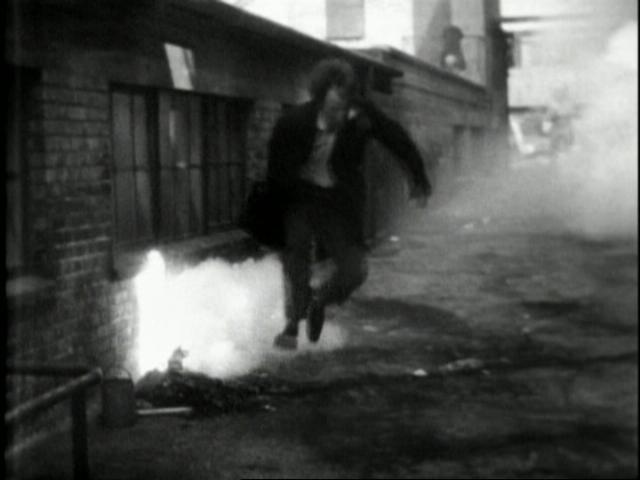
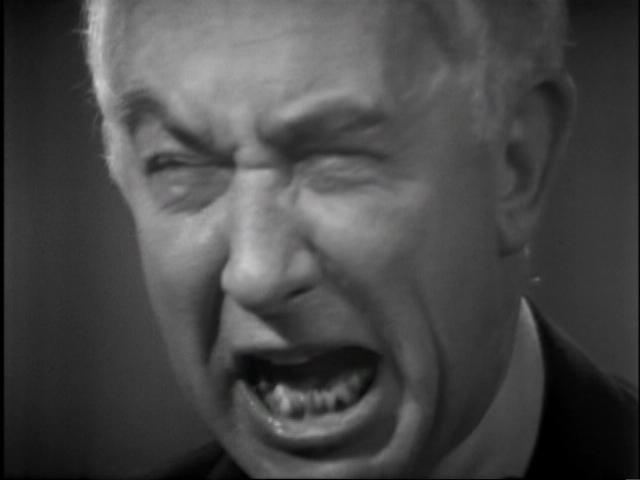
Doctor: Everything's got a weak point. It's just waiting until it shows up, that's all.
The Moonbase cemented the Cybermen, the villainous silver to the Daleks' gold, as classic Who villains. They had appeared a few stories before in The Tenth Planet, where they were the last villains faced by the First Doctor, and where their home planet of Mondas melted. With their second outing, they showed just exactly why they make such menacing and effective villains for the Doctor. Unfortunately, they also show the failings that crop up in nearly every adventure they show up in.

The TARDIS lands on the moon in the year 2070. Donning hilarious spacesuits, the Doctor, Ben, Polly, and Jamie wander the surface, having great fun with the low gravity until Jamie injures himself. They seek medical attention at a nearby moonbase. It's a crucial base, controlling Earth's weather with its Gravitron; losing power over the Gravitron could destroy all life on earth. Unfortunately, a mysterious disease ravages the crew and, far worse, the cybernetic horrors from Mondas assemble outside...
Wait, wait, wait... why are they controlling Earth's weather from the moon?

Even by 60s Who standards, that's just insane. The moon is about 250,000 miles away from the planet. Even if the weather-controlling machines were most effective from space, why would you even consider putting it a quarter of a million miles away rather than in a close Earth orbit? Also, the moon only faces one side of the earth at a time, which would seemingly negate controlling the whole planet effectively. And more importantly, why would you hang control of the weather on a single base? Wouldn't you want at least one backup?
Further, why would losing control of the weather result in the sort of catastrophic damage they suggest? The way it's set up here, a single system failure, and the entire planet is totally wiped out.
Soon, a crisis springs out when they accidentally send a hurricane off-course. Why, if they're controlling the weather, are they creating hurricanes? I could be misunderstanding, I suppose - they might be keeping a natural hurricane away from land, which I can definitely believe would form on its own if they're controlling the weather from the moon.
And are they controlling the weather with a giant gravity machine? On the moon?
Did I mention that this was written by Kit Pedler, a real scientist? Like, with degrees and published papers and everything?
I don't need much credibility in Doctor Who. Heck, I can roll with the Daleks planning to hollow out the Earth's core and replace it with an interstellar engine because you know what? The Daleks are insane, and it's awesome. I really don't need much to go on. But controlling the weather with a gravity machine on the moon? The setting is ludicrous in so many ways that it's difficult to get drawn into the story.
Anyway, there's the usual "let's have nobody trust the Doctor so we can procrastinate on having an actual plot for two episodes" stuff that plagues so many of Troughton's stories. (To be fair, this is the first time they pull that one, so points for originality, I guess.) The moonbase leader, Hobson, comes across as fairly daft, but he's likably portrayed by Patrick Barr. The rest of the personnel are pretty dull beyond their international makeup, which mostly consists of Andre Maranne's French accent, which I swear sounds like a spoof accent, even though he really is French. Maybe French accents just sound silly no matter how authentic they are. And what with the cravat and the flag on his shirt, Maranne’s Benoit is such an incredible French stereotype I kept expecting him to fight off the Cybermen with a wine bottle and baguette.
Although, notably, he doesn’t surrender. Presumably because he already surrendered to Hobson before the serial began.

Jamie, meanwhile, is barely conscious and hallucinating, terrified of the "Phantom Piper", according to the legends of his clan the spirit who takes you away when you die. This leads to the great cliffhanger of episode one, when a Cyberman appears in front of him and he assumes it to be the Piper.

Episode two begins with a genuinely unnerving moment when the Cyberman, after approaching the delerious Jamie, walks over to one of the diseased men and pulls him away from the bed. The man tries to resist for a moment, then goes limp, and is carried off quietly. It's incredibly creepy, and all the more so for how quiet it is.

Back to the weather plot and... the setup for the earth’s danger is just so unconvincing and goofy, it's hard to care. "We can't turn off the Gravitron. It would devastate half the globe - hurricanes, whirlwinds, storms..." I just can't take it seriously as a threat. It's well directed, acted, and silly enough that it isn't boring, but it doesn't work.
Then the Cyberman returns and again, silently takes away one of the diseased men. And again, its appearance is really frightening.

The rest of the episode mostly involves more of the hilarious spacesuits to do something or other and get captured by the Cybers or something, I don't know, I was way too busy laughing. There's also a slapstick bit with the Doctor trying to collect pieces of evidence and accidentally stealing someone's shoe. It's amusing, but not half as funny as the spacesuits.

And again, the episode recovers with a gripping second cliffhanger as Hobson argues with the Doctor that they searched the entire base and haven't found any sign of the Cybermen. The Doctor then looks around the medical ward and asks, "Did your people search in here?" Patrick Troughton's delivery is riveting, and their slow search around the room builds very skillfully, until finally, the Cyberman is revealed, and the credits roll. Granted, it doesn't make much sense, but I'll let the punch of the moment overcome that problem here.
And then... and then the Cyberman starts talking, and the more it talks, the less scary and less interesting it gets. It turns out they just want to wipe out all life on earth. They claim it isn't for revenge, but to "remove all danger." (they plan to do this with the weather control. Which is situated on the moon.) They also show strong signs of emotion, particularly the Cyberman gloating about his own cleverness - pure pride. Further, they're incredibly stupid: they recognize the Doctor, but pretty much give him free rein to defeat their plans, and they don't realize until very late in episode 3 that their guns don't work in the vacuum of space.
 |

To be fair, even as that, they are very physically threatening, and they work as villains. They just don't live up to their potential. Episode three picks up when the still-recovering Jamie teams up with Ben and Polly to try to take care of the Cyber-threat. Up until now, the companions haven't really had anything to do, and they don't really have much to do afterward, but there's a nice segment where they work together, and it's one of the few occasions when the Doctor having three companions actually works.
Jamie suggests destroying the Cybermen with Holy Water (awesome!), which goes on to inspire Polly's ingenius low-tech way of fighting the Cybers. Ben is also given a lot of usefulness in the scene. It's an excellent bit that uses all three companions very effectively as a team. I like their interaction afterwards:
Ben: Now, we'll need another one of these.
Jamie: Right, I'll get it.
Ben: No, you stand where you are.
Polly: Jamie, you're not well enough.
Jamie: It takes more than a wee crack on me head to keep a McCrimmon down.
Ben: Look, mate, we don't want you crackin' up on us. I'm sure Polly's very impressed, but...
Jamie: I said I was better! Now, you like me to prove it to you?
Ben: Anytime, mate.
Polly: Look, come on, haven't we got enough trouble without you two fighting each other?
Jamie: Well, I go!
Ben: Come on, then. [pause] Not you, Polly! This is men's work.
That's a lot of characterization in a small bit of dialogue, aided by the actors. Next time we see them, Polly insists on coming along, of course, and they argue a bit. Ben doesn't need much convincing - after all, he knows she's perfectly capable. Jamie gives up once Ben does and they attack.
For all the problems the Cybermen have, again, they're certainly physically intimidating, and the companion's assaults are very exciting. Their improvised weapons melt the Cybermen's life support systems, making their deaths a little disturbing, adding to the episode's overall emotional effect. (I'm really glad that shot survives in an otherwise missing episode) Ben's rescue of Benoit a few minutes later is also excellent, as he figures out how to make the liquid attack work in the vacuum outside.
And then we get a cool scene of an army of Cybermen marching on the moonbase, which, again, is a very strong cliffhanger. If nothing else, Cybermen make excellent cliffhangers. (this is really borne out in episode 4, when the cliffhanger for the next serial, The Macra Terror, falls totally flat) These are powerful, iconic images that make The Moonbase more memorable than it deserves.
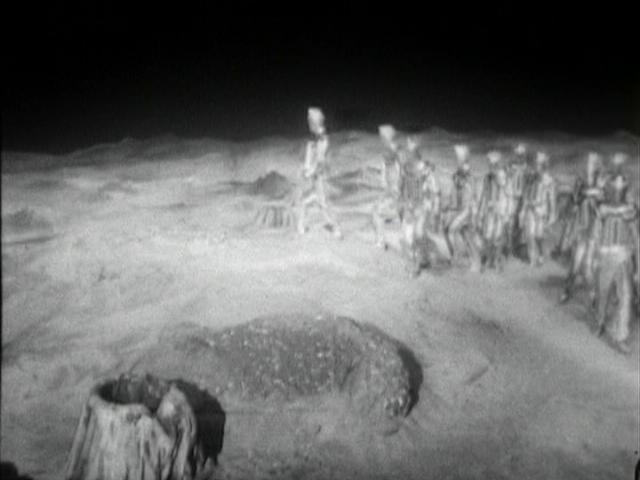
The fourth episode builds very nicely as we await the Cyber attack... and nothing really comes of it. They have a great plan at one point: shoot a hole in the station, causing the air to suck out.
Out heroes' solution: stuff a shirt in the hole.
Oddly enough, this works. For several seconds. Then it gets sucked out. Finally, they put a glass plate up, and the crisis is completely resolved and never mentioned again.
 |
| Problem solved! Back to work, people! |
Which begs the question: even if that wasn't idiotic on several levels, why don't the Cybermen just make a second hole? They do make an attempt some minutes later, by which point the Doctor has come up with a (ridiculous) solution, but why didn't they do it right away? The entire sequence is great conceptually, but terribly executed.
Other things happen in the fourth episode, most equally dumb. Benoit could have actually started fighting the Cybermen with a baguette and it wouldn't have lost any credibility.
The Cybermen get one of the diseased crewmen to take control of the gravitron, which would be very tense if he didn't just easily walk past everyone, despite not only having his nerves growing out of his face, but having a Cyber-hat-thing on his head, and obviously being deranged. But he just saunters into the gravitron control...
Eventually, the Doctor solves the problem in a cartoonish finale, and the story wraps up very lightheartedly.
I kinda sound like I didn't like the episode, and I certainly wasn't a huge fan - it is pretty stupid. But it's very watchably, entertaingly stupid.

And there's a lot of really good stuff in here. When it focuses on the Cybermen being creepy, it's terrific. The companions' counterattack in episode 3 is thrilling. The stock music is excellent throughout, and the modelwork on the base itself is superb. Frazier Hines doesn't have much to do as Jamie, and with Polly and Ben around, he hasn't really had time to develop the relationship with the Doctor that ultimately made him so engaging, but he's still very likable throughout. Michael Craze and Anneke Wills don't have much more to really do than he does, but they make everything they can of the material given them. Troughton is excellent, as usual. The moon exterior is pretty decent. And it's never boring, whatever else it may be. While it may not be a good serial overall, it's pretty enjoyable.
... but are they controlling the weather with a gravity machine on the moon?
RATING:
* * ½
SIDENOTES:
- The Cybermen recognize the Doctor, but he says they're "New to him," which is a nice little detail - the Cybermen have met the Second Doctor in their past, but his future. This would be much cooler if they didn't let him free so he could easily defeat them...
- I love the telescope in the background of the base. I like to think that even in an incredibly high-tech base of the future, they still have a low-tech telescope sitting on the observation deck. Near the end, it becomes more important because it turns out that other than the gravitron, this is a pretty low-tech base, but hey, gotta love the idea.

- For what it's worth, the reconstruction of the two missing episodes I watched was an excellent one done by johnnyfanboy on Youtube.
- Regardless of my reaction, this is a very important story. It really established the formula for the Troughton era.
- It established the Base Under Siege format as the usual go-to plot. It had shown up earlier in the season in Tenth Planet and Power of the Daleks, but this really shows what an all-purpose set-up it is - the perfect setting for any monster, even if the story overall wasn't as effective here than in those. Formulaic stupidity is much more sustainable than the What-In-The-Void-Are-We-Doing plotlessness of The Highlanders or the fairly dull stupidity of The Underwater Menace. The over-reliance on this story device is one of the greatest problems with the Troughton era, since it de-emphasizes his revolutionary characteristics and makes the whole thing incredibly repetitive, but that doesn't make it unimportant.
- It also emphasizes that the era is, in many ways, about the monsters. The First Doctor had numerous non-monster stories -- the various historicals, Planet of Giants, The Space Museum, arguably The Sensorites, depending on your definition of "monster" -- and outside of the Daleks, it struggled to come up with particularly memorable ones when it did go for it. (*cough cough chubblies cough*) With Troughton, on the other hand, we get Macra, Chameleons, Cybermen, Yeti, Ice Warriors, Cybermen, and even Cybermen. It's something carried down to the present day - the non-monster stories are the exceptions. I suppose in that way, it shaped much of what the show became for more than 40 years.
- It gives Troughton his first watchable story where he's more or less stabilized from the regeneration. He's still chaotic and unpredictable, but he doesn't seem like quite as much of a danger to his companions.
- All that doesn't make my like it any more - it's still just okay - but I do appreciate its place in context much better, and see its importance.